9 Free Quizlet Alternatives That Make Kids Actually Remember
Skyler Carr
Skyler Carr is the CEO of Mission.io and a former STEM specialist.
TL;DR: The best Quizlet alternatives make students come up with the answer before they see it, bring back the cards they missed, and eventually ask them to use the word on a real problem. Teachers may not need to switch at all: students in a Quizlet class get Learn and Test free on the class’s sets, and verified teachers can get a free year of Quizlet Plus. If you do switch, Knowt is the closest one-for-one swap and Anki has the strongest spaced repetition. Our pick for the last step, putting the vocabulary to work, is a Mission from Mission.io (ours, and labeled). All nine are below, along with the Flip Test for judging any flashcard tool. Updated November 2026.
Watch a kid study with flashcards and you’ll see the move. Read the front. Flip. Read the back. Nod. “Yeah, I knew that.” Next card. Forty cards in five minutes, a nod on every one, and then a 62 on Friday’s quiz that nobody saw coming, least of all the kid.
I call it flip-and-nod studying, and it’s how most flashcards get used, on paper or in Quizlet. The student never had to come up with the answer. They saw it and agreed with it. From the inside, recognizing an answer and remembering one feel exactly the same. On a test, they turn out to be very different skills.
Here’s where I’m coming from: I was a STEM specialist before I started Mission.io, and I handed out a lot of flashcard sets and watched a lot of nodding. Mission.io is #1 on this list. It’s ours, it’s labeled, and it isn’t a flashcard app, which I’ll explain when we get there.
Most Quizlet alternatives lists are written for students who are mad about the paywall. This one is for teachers, and the first answer may surprise you: the paywall might not be your problem.
Before you switch: you might not need a Quizlet alternative
Quizlet’s free plan now limits Learn and Test, which is why the switching lists exist. Classrooms get different treatment. When students join a class you created and study the sets you’ve added to it, they get unlimited, ad-free Learn and Test on those sets. Quizlet also offers verified teachers a free year of Quizlet Plus for teachers, checked against a school email address. And Quizlet Live, the team game, still runs from a teacher account.
So if price was your only reason for leaving, set up a class and you’re done. (You can close the tab now. I’d rather you didn’t.) The better reason to look around is what a flashcard can and can’t tell you about what your students actually know.
Why flashcards stop working: the flip-and-nod problem
Students are poor judges of what they’ve learned, and flashcards make it easy to be wrong in a comfortable direction. Nate Kornell and Robert Bjork studied a habit nearly every student has: setting aside the cards they think they know. The logic sounds fine, since it frees up time for the hard cards. The catch is that students drop cards on a feeling of knowing, and overconfidence leads them to drop too many and study too little.
Kornell found a second trap in a study of flashcard spacing. Working through one big stack spread over time beat studying small stacks in quick bursts for 90% of participants. After the first session, 72% of them believed the opposite. The method that worked felt worse, and the method that felt better didn’t work, which is a hard thing to ask a fourteen-year-old to trust.
“Recognizing an answer and remembering it feel identical from the inside. Only one of them shows up on Friday.” (Skyler Carr, CEO of Mission.io)
The Flip Test: three questions for any Quizlet alternative
Before you move your sets anywhere, run the tool through three questions. They’re the flashcard cousin of the Scoreboard Test we use for Kahoot, Blooket, and Gimkit.
1. Before the card flips, does the student commit to an answer? Typing it, writing it, or saying it out loud to a partner all count. Picking from four choices is mostly recognition, and so is the nod. This line between recall and recognition matters more than any feature on a pricing page.
2. Do the misses come back, spaced out? A good tool brings back the cards a student got wrong, and brings them back later instead of right away. That’s spaced repetition, and students skip it on their own because it feels slower.
3. Does the student ever have to use it? Defining photosynthesis is a flashcard. Explaining why the plant in the supply closet died is science. Flashcard tools can get students to the first one, and that’s why #1 on this list isn’t a flashcard tool.
A tool that passes the first two questions is a good study tool. Passing the third takes something other than flashcards.
Quizlet alternatives at a glance
| Tool | Does the student produce the answer? | Do misses come back? | Imports Quizlet sets | Free version |
|---|---|---|---|---|
| A Mission (Mission.io) | Students use the content on a problem | Not a flashcard tool | No | Free to start |
| Knowt | Yes, in written Learn questions | Yes, spaced repetition | Yes, one click | Yes, with ads |
| Anki | Yes, then self-graded | Yes, built around it | Through a text export | Yes (iPhone app is paid) |
| Gimkit | Yes, with text-input questions | Questions cycle back in a game | Through a spreadsheet | Yes, Basic plan |
| Blooket | Mostly multiple choice | No | Yes, built in | Yes |
| Wayground (formerly Quizizz) | Mostly multiple choice | Depends on how you assign | Through a spreadsheet | Yes, Starter plan |
| The Leitner box | Yes | Yes, built in | Copy by hand | Free (paper) |
| The brain dump | Yes | You decide | Not needed | Free (paper) |
| Whiteboard Showdown | Yes | You decide | Not needed | Free (whiteboards) |
Our pick for the third question
1. A Mission (Mission.io)
Full disclosure: Mission.io is ours, so weigh this accordingly. Every other tool here helps students hold on to terms. A Mission asks them to use those terms on a problem. It’s a teacher-led, whole-class simulation built from the standard you’re teaching. The class becomes a spaceship crew, a lab team, or a city in the middle of an outbreak, and students have to read the data, figure out what’s going wrong, and make the calls together. Last week’s vocabulary list turns into the language the crew needs to get home.
Every student has a station and a job, so nobody nods along from the back row. Students earn points for the choices and teamwork that move the class forward, and the class score is the average of everyone’s, ranked against classes around the world that ran the same Mission. Prep is picking the Mission. Our software connects every student and runs the work at each station, which leaves you free to walk the room and ask kids to explain their thinking.
We’ve put it to the test. In a 2025-26 study of 1,039 fifth graders across 53 classrooms, conducted by Instructure, students who ran Missions scored significantly higher in content knowledge than students who didn’t (g = 0.335, p < .001), and the more Missions they ran, the higher they scored (+0.0094 proportion correct per session, p < .001). The study meets ESSA’s Moderate Evidence bar (Level II). Free to start.
Use it after the flashcards. Spend a week on the unit’s terms in any tool below, then run a Mission where students need those same words to get through it. The flashcards tell you who recognizes the words, and the Mission shows you who can use them.
Pick a Mission for your grade
| Grade | Try this Mission | Standard | More for your grade |
|---|---|---|---|
| Every grade, first | The Communication Mission: K-1, 2-3, 4-8 | None (class training) | Run this one first. It gives your class the training to run any Mission in the library. |
| 3rd | Melting Point | 3-ESS2-1, 3-ESS2-2 | 3rd grade science activities |
| 4th | Landslide | 4-ESS2-1 | 4th grade science activities |
| 5th | Matter Matters | 5-PS1-2 | 5th grade science activities |
| 6th-8th | The State of Things | MS-PS1-4 | 6th, 7th, 8th grade science activities |
| 6th-8th, short on time | Storm Front (16 minutes) | MS-ESS2-5 | Same as above |
Teaching K-2? Start with the kindergarten, 1st grade, and 2nd grade science pages.
Digital Quizlet alternatives
2. Knowt
The closest thing to a one-for-one swap. Knowt imports Quizlet sets in one click and keeps its Learn mode free, along with spaced repetition, practice tests, and a matching game. Teachers can set up classes, share sets, and see which cards the class is struggling with. The free version runs on ads. On the Flip Test, steer students toward the written questions in Learn mode and let spaced repetition handle the misses, and it passes the first two.
3. Anki
The heavyweight of spaced repetition and a longtime favorite of medical students and serious language learners. Students see the front, answer from memory, flip, and grade themselves, and Anki schedules each card from that grade. It’s free and open source on desktop and Android, and the iPhone app is a one-time purchase. It passes the first two Flip Test questions better than anything here, as long as students grade themselves honestly. It also looks like software from another decade, so it fits motivated high schoolers better than a whole seventh-grade class.
4. Gimkit
Gimkit turns a set into a game where right answers earn in-game cash, and questions cycle back so students see each term several times. The setting most teachers miss is text input: switch a question to it and students type the answer instead of picking it, which turns Gimkit from a recognition game into a recall one. Kits import from a spreadsheet. With typed answers it passes the first Flip Test question and partly passes the second. The mode matters a lot too, and we rank every one in our guide to Gimkit’s game modes.
5. Blooket
If your sets already live in Quizlet, Blooket has a built-in Quizlet import, so moving them takes a couple of minutes. Kids love it, and nothing on this list brings more energy. Most Blooket questions are multiple choice, though, and in modes like Gold Quest luck decides a lot of the scoreboard, so it fails the first Flip Test question as usually played. Save it for the fun review at the end of a unit. More in games like Blooket.
6. Wayground (formerly Quizizz)
Wayground’s free Starter plan for teachers includes flashcards alongside quizzes, presentations, and reading passages, and it can turn an existing assessment into a flashcard set. Pick it if you want flashcards and quizzes in one place, with reports on what each student missed. Most of its question types are multiple choice, so it leans toward recognition unless you choose open-ended questions on purpose.
No-tech Quizlet alternatives that pass the Flip Test
The best flashcard tool in your building might be a stack of index cards. All three of these cost nothing but paper or a whiteboard, and all three pass the first question by design.
7. The Leitner box
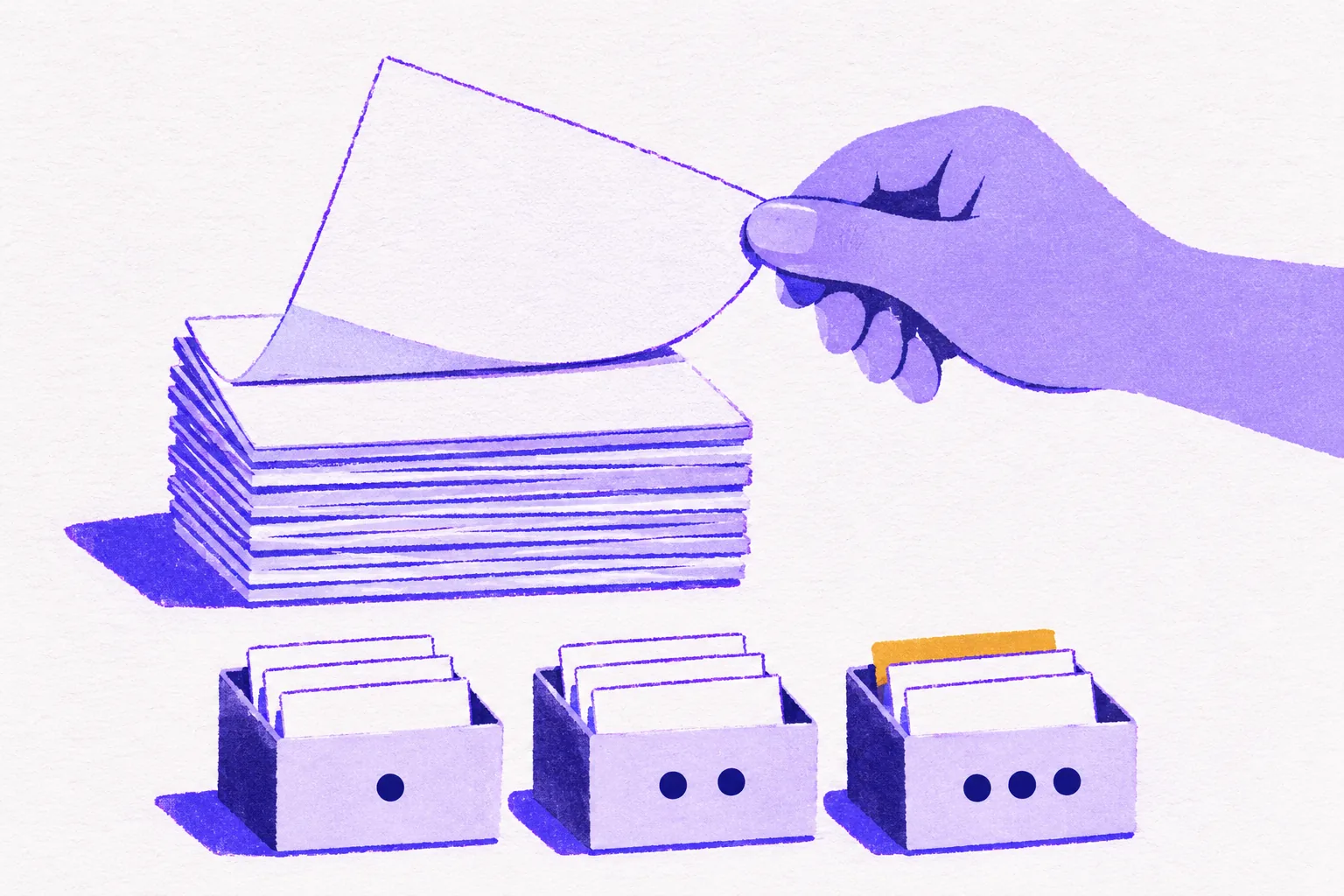
Spaced repetition on paper, popularized by the German science writer Sebastian Leitner in the 1970s. Students make their own cards, which helps them remember on its own, and keep three envelopes or boxes. Every card starts in Box 1. A card answered correctly moves up a box, and a miss goes back to Box 1. Box 1 gets studied every day, Box 2 every few days, Box 3 once a week. Students say or write the answer before they flip, so it passes the first two questions with nothing to install.
8. The brain dump
Give students two minutes and a blank page: write everything you remember about the unit, with no notes and no word bank. Then they open their notes and fill the gaps in a different color. There’s nothing to recognize, so it’s retrieval practice in its purest form. The colored ink shows each student what to study next, and it shows you what to reteach.
9. Whiteboard Showdown
The group version. Read a term or question, everyone writes an answer on a mini whiteboard, and every board flips at once. Nobody can nod along, and you can scan the room for misses in two seconds. It’s one of the games in our list of review games where everyone has to think.
Which Quizlet alternative should you use?
- Staying with Quizlet but stuck on the paywall: set up a Quizlet class, or verify for the free teacher year.
- A drop-in replacement for your existing sets: Knowt.
- Serious self-study for older students: Anki, or a Leitner box on paper.
- Review with some energy: Gimkit with typed answers, or Blooket on the last day of a unit.
- Flashcards and quizzes in one place: Wayground.
- Finding out whether students can use the words: a Mission.
Make them say it before they flip
Whatever tool you land on, one rule matters more than the rest: students commit to an answer before the card flips, typed, written, or said out loud to the kid next to them. Then the misses come back next week. Once they know the words, give them a problem that needs those words, because that’s the one test a flashcard can’t run. The nod can stay. It just has to come after the answer.
Frequently asked questions
What is the best free alternative to Quizlet?
For students, Knowt is the closest free swap: it imports Quizlet sets in one click and keeps Learn mode, spaced repetition, and practice tests free. Anki is the strongest free spaced-repetition tool for older students. For teachers, Quizlet may be free enough, since students in a teacher’s Quizlet class get unlimited Learn and Test on the class’s sets. For applying vocabulary, Mission.io runs whole-class simulations that are free to start.
Is Quizlet still free for teachers?
Yes, with limits. Teachers can create sets and classes for free, and students in a teacher’s class get unlimited, ad-free Learn and Test on the sets in that class. Quizlet also offers verified teachers a free year of Quizlet Plus for teachers, verified with a school email address. Extras such as custom teams in Quizlet Live come with the paid teacher plan.
Can I import my Quizlet sets into another app?
Yes. Knowt imports Quizlet sets in one click, and Blooket has a built-in Quizlet import. Gimkit, Wayground, and Anki take sets through a spreadsheet or text import, so export the set from Quizlet as text first and clean up the formatting. Check the imported set before you play it with a class.
Are flashcards good for learning?
Flashcards work well when students produce the answer before flipping and when study is spread out over time. In research by Nate Kornell, spacing flashcard study beat cramming for 90% of participants, though 72% believed cramming had worked better after the first session. Flashcards are weaker for applying knowledge, so pair them with an activity where students use the terms, such as a Mission from Mission.io.
What is the best Quizlet alternative for the classroom?
For whole-class review where every student answers, Whiteboard Showdown needs only mini whiteboards, and Gimkit works well with typed answers. For a game with energy, Blooket imports Quizlet sets directly. For checking whether students can apply the vocabulary instead of only recognizing it, a Mission from Mission.io puts the whole class on one problem that needs those terms.
What is the Flip Test?
The Flip Test is a three-question check for any flashcard or study tool. First, does the student commit to an answer before seeing it? Second, do missed cards come back, spaced out over time? Third, does the student ever have to use the content on a new problem? Tools that pass the first two are strong study tools. The third takes an activity like a Mission.