Kahoot vs Blooket vs Gimkit: Which Is Best for Learning?
Skyler Carr
Skyler Carr is the CEO of Mission.io and a former STEM specialist.
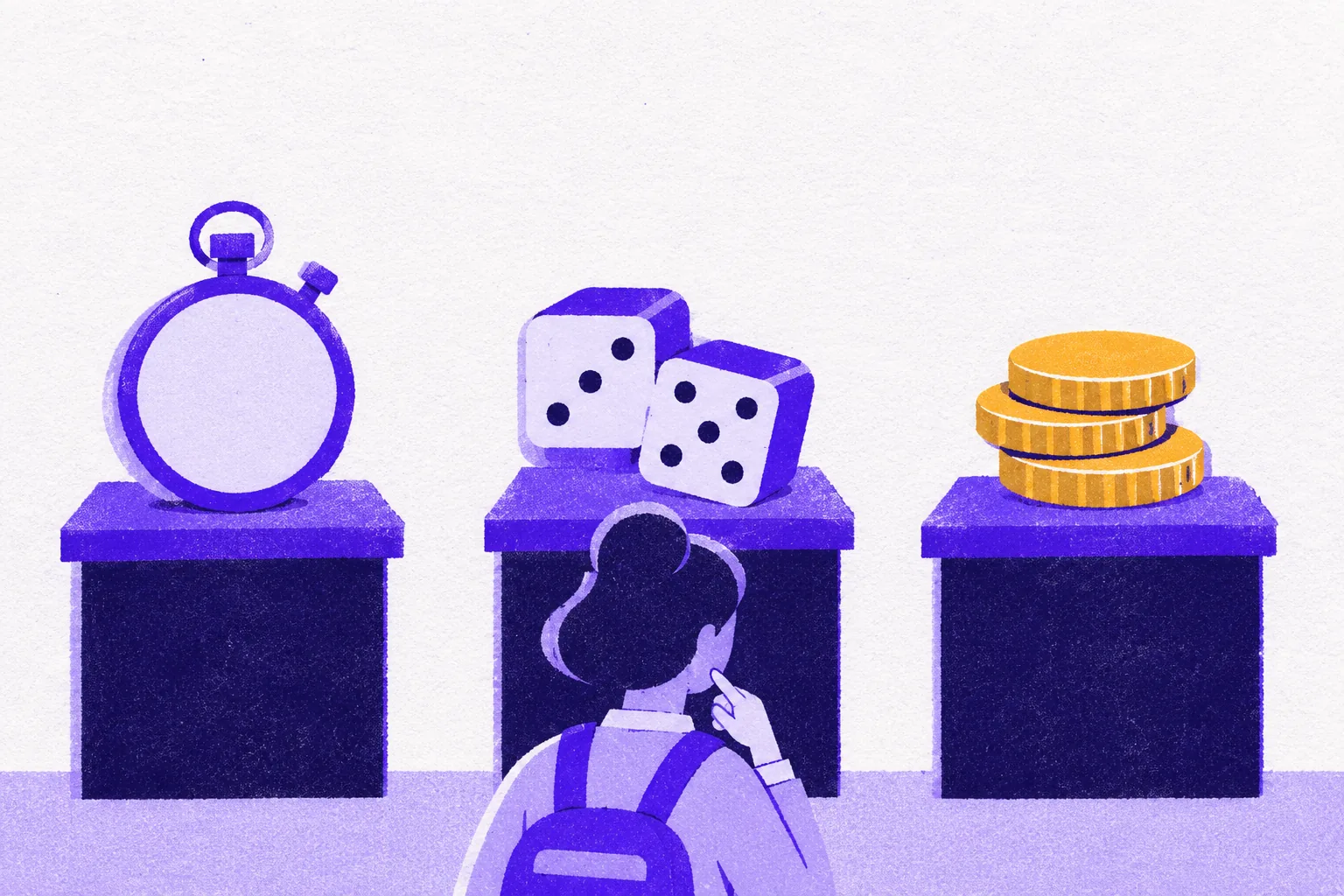
TL;DR: Kahoot, Blooket, and Gimkit all turn review into a game, and each one pays students for something different. Kahoot pays for speed, Blooket for luck, and Gimkit for in-game cash. For learning, Gimkit usually comes out ahead, because right answers drive progress and questions repeat for practice. Kahoot is the best of the three for a teacher-led check, since the whole class sees the same question and you control the pace. Blooket is the most fun and the least reliable read on what kids know. A comparison table, a one-question test for any classroom game, and a Mission for your grade are below. Updated November 2026.
If you’re choosing between Kahoot, Blooket, and Gimkit, you’ve already made the important call. You picked a game over another review packet, and your class will thank you for it. What’s left is which one, and most comparisons answer that with a feature list: game modes, player caps, price.
The features matter less than what each game pays students for. Kahoot pays them for being fast. Blooket pays them for being lucky. Gimkit pays them in cash they can reinvest. Students work out fast what a game rewards, and that’s what they end up practicing, so it’s the comparison worth making.
One thing before you read on: I was a STEM specialist before I started Mission.io, and Mission.io makes Missions, which compete with all three of these for your class time. I’ve tried to be fair to each. You can decide whether I managed it.
Kahoot vs Blooket vs Gimkit at a glance
| Kahoot | Blooket | Gimkit | |
|---|---|---|---|
| What wins the round | Fast, correct answers | Correct answers plus lucky rewards (and stealing, in some modes) | Correct answers turned into cash, then smart spending |
| Who sets the pace | You. Everyone answers the same question at the same time | Each student, at their own pace | Each student, at their own pace |
| Best for | A quick teacher-led check before you teach the next thing | Energy, younger grades, a reward day | Repeated practice with older students before a test |
| The trap | Speed: the fastest tap wins | Luck: the chest decides more than the knowledge | The economy: students optimize cash, not content |
| Free plan | Kahoot! Go, up to 40 players for K-12 teachers | Up to 60 players | Basic, with about three game modes in rotation |
The Scoreboard Test: one question for any classroom game
Five minutes into any of these games, look at the leaderboard and ask why the kid in first place is winning. If the answer is “she knows the material,” the game is doing its job. If it’s “he’s fast,” “she got lucky,” or “he bought the multiplier early,” the game is teaching something other than your lesson.
I call it the Scoreboard Test. It’s the short version of the three-question tests in our deeper guides: the Speed Trap Test for Kahoot, the Sabotage Test for Blooket, and the Interest Test for Gimkit. Each game fails it in a different direction, and each can pass it more often if you set it up right.
“Kids are brilliant at figuring out what a game actually rewards. Pick the game, and you’ve picked what they’ll practice.” (Skyler Carr, CEO of Mission.io)
Kahoot: the shared moment, paid for in speed
Kahoot’s real strength is that the whole class is on the same question at the same moment, and you decide when to move on. When the answer chart shows half the room picked the wrong color, you can stop and teach right there. Blooket and Gimkit can’t give you that pause, because by then every student is on a different question.
The cost is speed. A right answer is worth more points the faster it comes in, so the kid who reads quickly and taps first beats the kid who works it out. Ask a question that takes real reasoning and you can watch the careful thinkers stop trying by question four. That’s the Speed Trap, and we take it apart in our guide to Kahoot alternatives.
To get the most out of it, run Kahoot at the start of a lesson to find out what’s shaky, keep it to eight or ten questions, and stop on every question where the class splits. Team mode helps too, since groups get a few seconds to talk before they answer.
Blooket: the most fun, paid for in luck
Blooket is the one kids ask for by name. They answer at their own pace, collect Blooks, and play modes like Gold Quest and Tower Defense, with seasonal modes rotating in through the year. For pure energy, the other two don’t come close.
The catch is how the rewards work. In Gold Quest, a right answer earns a pick from three chests, and the chest might hold gold, cost you gold, or let you steal from a classmate. Two students who know exactly the same amount can finish miles apart, so the leaderboard ends up measuring luck and nerve as much as understanding. It’s the least reliable read of what your class knows. More on that in games like Blooket.
To get the most out of it, save Blooket for material students already know, choose modes without stealing when the review really matters, and don’t read much into who won.
Gimkit: the smartest of the three, paid in cash
Gimkit pays right answers in cash, and students spend that cash on upgrades that make every later answer worth more. It’s the only one of the three where planning ahead pays off, and because questions cycle back through the game, students get real repetition.
That’s also its trap. Give students an economy and they’ll play the economy. By the middle of a round the leader is often whoever invested early, and because the same questions keep coming back, sharp students start recognizing answers by their shape instead of their meaning. We call it the Economy Trap and break it down in games like Gimkit.
To get the most out of it, use team mode, keep sessions short, and build a kit big enough that questions don’t repeat too fast. The free Basic plan rotates which modes are available, so check before you plan a lesson around a favorite.
So which is best for learning?
If learning is the tiebreaker, my ranking is Gimkit, then Kahoot, then Blooket. Gimkit ties progress most closely to right answers and packs the most practice into a few minutes. Kahoot comes second because of the pause: with everyone on the same question, you can catch a misconception the moment it shows up and fix it on the spot. Blooket comes third because luck decides too much of the outcome, though it wins on fun, especially in elementary.
Grade level shifts the answer a little. Blooket’s look skews young, and plenty of high schoolers find it babyish. Gimkit’s strategy layer lands best with middle and high school students who love to optimize. Kahoot works at nearly any age because there’s so little to learn.
What none of the three can do
All three share the same ceiling. They’re review, and they check whether each student, on their own device, can recognize the right answer. That’s useful. What none of them do is ask the class to take what they learned and use it on something new, together, where one student’s idea can get everyone else through.
That’s the gap Missions fill. Full disclosure again: Mission.io is ours, so weigh this accordingly. A Mission is a teacher-led, whole-class simulation built from the standard you’re teaching. The class becomes a spaceship crew, a lab team, or a city in the middle of an outbreak, and students have to diagnose what’s going wrong, weigh the evidence, and make the calls together. Our software connects every student and runs the work at each station, which leaves you free to lead the discussion and push for evidence. There’s no shop, no chests, and nobody wins by tapping first. Students do earn points, for the choices and teamwork that move the class forward, but the class score is the average of everyone’s, and the leaderboard ranks it against classes around the world that ran the same Mission. The only way up is together. Run the Scoreboard Test on that one, and the answer to “why is this class winning?” is that they worked it out as a team.
It’s also the one on this page we can back with our own data. In a 2025-26 study of 1,039 fifth graders across 53 classrooms, conducted by Instructure, students who ran Missions scored significantly higher in content knowledge than students who didn’t (g = 0.335, p < .001), and the more Missions they ran, the higher they scored (+0.0094 proportion correct per session, p < .001). The study meets ESSA’s Moderate Evidence bar (Level II). Free to start.
You don’t have to choose between a game and a Mission. Warm up with ten minutes of Kahoot, Blooket, or Gimkit on the unit’s vocabulary, then close the game and launch a Mission where students need those same words to get through. The game gets them talking about the content, and the Mission is where they find out whether they can use it.
Pick a Mission for your grade
| Grade | Try this Mission | Standard | More for your grade |
|---|---|---|---|
| 3rd | Melting Point | 3-ESS2-1, 3-ESS2-2 | 3rd grade science activities |
| 4th | Landslide | 4-ESS2-1 | 4th grade science activities |
| 5th | Matter Matters | 5-PS1-2 | 5th grade science activities |
| 6th-8th | The State of Things | MS-PS1-4 | 6th, 7th, 8th grade science activities |
| 6th-8th, short on time | Storm Front (16 minutes) | MS-ESS2-5 | Same as above |
Teaching K-2? Start with the kindergarten, 1st grade, and 2nd grade science pages.
Pick the payout
Kahoot, Blooket, and Gimkit all beat a packet, and your class knows it. Pick the one whose payout does the least damage to the lesson you’re teaching that day, run the Scoreboard Test five minutes in, and save the biggest moment of the unit for something the whole class has to do together.
Frequently asked questions
Which is best for learning: Kahoot, Blooket, or Gimkit?
Gimkit usually supports learning best, because correct answers drive progress and questions repeat for practice. Kahoot is second: it rewards speed, but every student sees the same question at once, so the teacher can pause and reteach. Blooket is the most fun, but luck and stealing decide much of the outcome, so its scores say less about what students know.
Is Blooket better than Kahoot?
Blooket is better for energy and independent, self-paced play, especially with younger students. Kahoot is better for a teacher-led check, because the whole class answers the same question at the same time and you control when to move on. Kahoot rewards speed and Blooket rewards luck, so neither is a reliable grade on its own.
Is Gimkit better than Blooket?
For learning, usually yes. Gimkit ties progress to right answers and repeats questions for practice, while Blooket’s random chest rewards can outweigh what students know. Gimkit’s risk is that students focus on earning and spending in-game cash instead of the content, so team mode and short sessions help.
Are Kahoot, Blooket, and Gimkit free?
All three have free plans for teachers. Kahoot! Go is free for K-12 teachers with up to 40 players per game. Blooket’s free plan hosts up to 60 players, with Plus from about $5 a month billed yearly. Gimkit Basic is free with about three game modes in rotation, and Gimkit Pro is about $60 a year. Check each site for current pricing.
Which is best for elementary, middle, or high school?
Blooket fits elementary best, since its look and characters skew young. Gimkit’s strategy layer lands best with middle and high school students. Kahoot works across grades because it’s simple to join and play.
What’s an alternative to Kahoot, Blooket, and Gimkit?
For other review games, see our guides to Kahoot alternatives, games like Blooket, and games like Gimkit. For applying a unit instead of reviewing it, Mission.io runs teacher-led, whole-class simulations where students use what they learned to work through a real scenario together. It’s free to start.