
Share this
by Skyler Carr on August 12, 2025
TL;DR: The best Kahoot alternatives swap speed for thinking. They reward understanding and collaboration over who taps the screen first. Our top picks: Mission.io for whole-class collaborative learning, Wayground (formerly Quizizz) for self-paced review, and Gimkit for strategy-based practice. The full list of 10, a comparison table, and a three-question test for choosing are below. Updated September 2026.
Kahoot is the most popular game in the classroom. It's also a speed-clicking contest with a soundtrack. That's fine for ninety seconds of energy on a Friday. The problem is what happens when you go looking for something better and every "alternative" turns out to be the same contest in a different costume.
Here's where I'm coming from, and you should weigh it accordingly: I run a company that builds classroom software, so I have every reason to tell you screens are the answer. I'm also the guy who once lost his composure during a third-grade review game because a nine-year-old beat me to the buzzer. Competitiveness is a feature in a founder and a bug in a grown man playing Blooket against children. So I know the pull of these tools from both sides.
I'm not the only one who thinks this. When the New York Times took apart classroom screen time in 2026, it spent most of a brutal essay on what edtech got wrong, then held up Mission.io as the exception, the company "trying to do gamification the right way." (The no-login version is here.) I'll still tell you most classroom games are mostly noise. Now I have it in print.
The uncomfortable truth in my industry is that the fastest way to get a teacher to love your product is to make it addictive. Making it work is slower and harder. Kahoot is exhibit A. Most of its alternatives are exhibits B through K. This guide is about the handful doing something different, and a quick way to tell which is which.
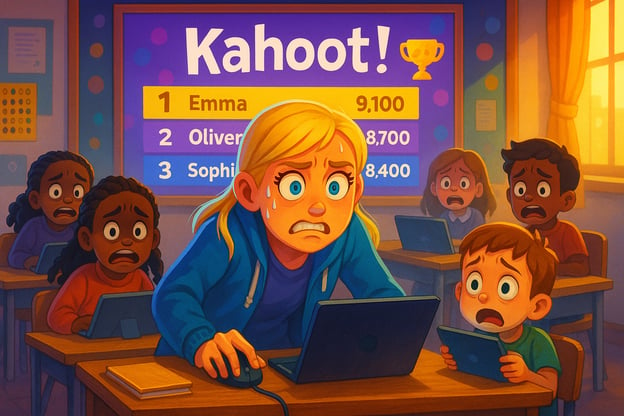
Kahoot Isn't the Problem. The Speed Trap Is.
Kahoot does one thing well: it raises the energy in a room fast. Ask anyone who has run it and they'll tell you the same thing. Ask them what students learned and the room goes quiet. That gap is the whole issue.
I'll even hand Kahoot the point. In our own Spring 2026 survey of 101 teachers, game-based review tools like Kahoot and Blooket were rated the most engaging thing in the classroom, with 92% of teachers saying students were highly or exceptionally engaged during them. A Mission came in at 90%. I believe every one of those teachers. Engagement was never the argument.
The mechanic that makes Kahoot fun is the same one that caps what it can teach. When points are tied to speed, students optimize for speed. A 2024 study of Kahoot in a language classroom found it pushed students to answer quickly rather than accurately, bred a sense of inadequacy among lower-ranked students, and undermined the engagement it was supposed to create. The podium rewards the kid who already knew the answer and quietly punishes the one who needed a beat to think.
I have a name for this, borrowed from a fight I picked a while back about gamification in education: competification. It's what happens when you bolt a leaderboard onto a quiz and call it a game. Real gamification changes how students think. Competification just changes how fast they tap.
"A leaderboard tells you who was fastest. It has never once told you who understood." -- Skyler Carr, CEO of Mission.io
The Speed Trap Test: 3 Questions Before You Trust Any Classroom Game
Before you swap Kahoot for the next shiny tool, run it through three questions. I call it the Speed Trap Test. If a tool fails all three, you haven't found an alternative. You've found a reskin.
1. Does it reward thinking or speed?
Can a slower, more thoughtful student win, or does the fastest finger always take the podium? Tools that let students answer at their own pace pass. Tools that pay out for raw speed don't.
2. Does it make students work together or only against each other?
Competition is healthy in small doses. But if the only social mode is "beat your classmates," the tool is teaching a lesson about status, not about the subject.
3. Does it show you what they actually learned?
A score tells you who won. Good tools tell you who understood, where the class got stuck, and what to reteach tomorrow. If all you get is a ranking, you're flying blind.
No tool aces all three every time, and that's fine. The point is to choose with your eyes open instead of grabbing whatever has the loudest sound effects.
10 Kahoot Alternatives, Ranked by What They Actually Teach
Ten tools worth your time, scored against the Speed Trap Test. Most have a real free tier. Each is good at something specific, so match the tool to the goal, not the other way around.
1. Mission.io
Mission.io is ours, so weigh this entry accordingly. A Mission is a teacher-led, whole-class simulation. Your room becomes the crew of a spaceship or a rescue team, the crisis is built out of whatever you've been teaching, and students have to weigh evidence, argue decisions, and make calls together to move the story forward. You're at the helm. The Mission carries the pacing and the data.
Run it as a game day and it already beats thirty separate screens, because the whole class is inside one story. Run it as the event a unit builds toward and it does something a quiz game can't. In a 2025-26 study of 1,039 fifth graders across 53 classrooms, conducted by Instructure, students who ran Missions scored significantly higher in content knowledge than students who didn't (g = 0.335, p < .001), and the more Missions they ran, the higher they scored (+0.0094 proportion correct per session, p < .001). The study meets ESSA's Moderate Evidence bar (Level II). Best for deep collaboration and real application. Built for the two questions most game-show apps skip: are students working together, and can you see what they learned.
2. Wayground (formerly Quizizz)
Wayground is a flexible quiz platform built around self-paced play. Students answer on their own clock instead of racing the room, which takes the speed pressure off and lets slower thinkers think. It covers everything from algebra to reading comprehension, with difficulty that adapts. Best for review, practice, and differentiated instruction. Passes the speed and learning-visibility questions.
3. Slides With Friends
Slides With Friends pulls the whole room into a shared slideshow with polls, word clouds, photo sharing, and prompts. It leans toward voice and reflection rather than right-answer racing. Best for small-group work, team-building, and coaxing reflection out of quiet students. Strong on collaboration.
4. Blooket
Blooket is free and fast, a real crowd-pleaser with game modes that layer power-ups and rewards on top of a quiz. It's closer to Kahoot's DNA than most on this list, which means it's energetic but still leans on speed. Best for motivating younger students and making end-of-unit review feel less like review. Great fun, lighter on learning visibility. (If that's the rabbit hole you're in, we have a Blooket alternatives guide too.)
5. Baamboozle
Baamboozle runs on a single screen with no student devices, which makes it the rare tool you can launch in a room full of kids without laptops. Teams take turns, so it's collaborative by design. Best for quick whole-class review in lower grades and any classroom that isn't one-to-one. Passes the collaboration question easily.
6. Quizlet
Quizlet is the study-set workhorse: flashcards, spaced repetition, and practice tests for vocabulary, equations, and test prep. It's built for individual retrieval practice rather than group play, and it does that job better than anything else here. Best for homework, test prep, and quiet work periods. Not a group tool, but honest about it.
7. Mentimeter
Mentimeter is a clean presentation tool with live polls, word clouds, and Q&A that can run anonymously. The anonymity matters: students who would never raise a hand will answer when no one can see their name on it. Best for open-ended discussion and finding out what a quiet class really thinks. Strong on learning visibility for higher-order questions.
8. Gimkit
Gimkit was built by a high school student, and it shows, in the best way. Students earn in-game currency for correct answers and make strategic choices about how to spend it, so there's a thinking layer on top of the quiz. Its Smart Repetition feature resurfaces missed concepts. Best for formative assessment with a strategy twist. Passes the thinking question more than most game-show tools. (Hunting for Gimkit alternatives specifically? Same test applies.)
9. Pear Deck
Pear Deck makes Google Slides interactive, with embedded questions, drag-and-drop, and reflection prompts built into the lecture. It keeps students responding throughout a lesson instead of zoning out. Best for live instruction where you want a pulse-check every few slides. Strong on learning visibility.
10. Factile
Factile is Jeopardy for the classroom, built around teams and customizable for any subject. Because it runs on teams rather than individuals, the competition is shared instead of solitary, which softens the speed-trap problem. Best for collaborative review and exam prep. Passes the collaboration question.
Quick Comparison: 10 Kahoot Alternatives at a Glance
| Tool | Best for | Collaborative or competitive | Free tier |
|---|---|---|---|
| Mission.io | Whole-class collaborative learning | Collaborative | Yes |
| Wayground | Self-paced review and practice | Either (self-paced) | Yes |
| Slides With Friends | Discussion and team-building | Collaborative | Yes |
| Blooket | High-energy review, younger grades | Competitive | Yes |
| Baamboozle | No-device whole-class review | Collaborative (teams) | Yes |
| Quizlet | Individual study and test prep | Individual | Yes |
| Mentimeter | Anonymous discussion and polling | Collaborative | Yes |
| Gimkit | Strategy-based formative assessment | Competitive (with strategy) | Limited |
| Pear Deck | Interactive live lessons | Either | Limited |
| Factile | Team-based review and exam prep | Collaborative (teams) | Yes |
How to Use These Without Falling Back Into the Speed Trap
The best classrooms don't pick one tool. They stack them: a competitive tool to bring the energy, a collaborative one to spend it on thinking.
Picture a fractions unit. You open with a round of Factile for review, teams against teams, and the room gets loud in the good way. Then, while they're still warmed up, you launch a Mission where the class has to use those same fractions to work its way out of an actual problem together, no leaderboard in sight. Better yet, tell them on day one of the unit that they're going to need this. The game gets them in the door. The Mission is where the fractions get used.
Two rules make this work. Set expectations before you launch anything, so students know what good participation looks like and the game doesn't turn into pure chaos. And mix competitive and cooperative on purpose. A leaderboard is a seasoning, not the meal.
The Bottom Line
Kahoot is the academic equivalent of an energy drink. Useful for a jolt, a problem if it's the whole diet. Leaving it for a quieter quiz game misses the point. Leave it because you're done confusing noise with learning.
So run the Speed Trap Test on whatever you try next. Ask whether it rewards thinking, whether it brings students together, and whether it shows you what they learned. If the answer to all three is no, you haven't upgraded from Kahoot. You've changed the soundtrack.
Frequently Asked Questions
What is the best free Kahoot alternative?
For most classrooms, the strongest free options are Blooket and Baamboozle for quick review, Wayground (formerly Quizizz) for self-paced practice, and Mission.io for whole-class collaborative learning. Baamboozle stands out because it needs only one screen and no student devices, which makes it usable in classrooms that are not one-to-one. The right choice depends on whether your goal is energy, practice, or deeper collaboration.
Is Kahoot good for learning?
Kahoot is good at raising energy and running a fast review, but it is built around speed rather than understanding. A 2024 study found that timed, points-for-speed play can push students to answer quickly instead of accurately and can discourage lower-ranked students. It works best as a warm-up or a brain break, not as the main way students engage with new material.
What is a less competitive alternative to Kahoot?
For a calmer, more collaborative experience, look at Mission.io, Slides With Friends, Baamboozle, or Mentimeter. These tools emphasize teamwork, discussion, or self-paced response instead of racing classmates to a podium. Mentimeter even allows anonymous answers, which lowers the social pressure for students who freeze up when their name might land on a scoreboard.
What is the best Kahoot alternative for large groups or whole classes?
For large groups, Baamboozle and Factile work well because they run on a single shared screen and organize students into teams rather than individuals. Mission.io is built for whole-class play by design, putting the entire room inside one shared challenge. These options keep everyone involved without requiring a device in every student's hands.
Are there Kahoot alternatives that do not require student logins or devices?
Yes. Baamboozle is the clearest example: it runs on one screen, needs no student accounts, and works through teams, so students participate without logging in or holding a device. Factile can also be run from a single classroom display. These are the easiest options for younger grades or rooms where one-to-one devices are not available.