
Share this
by Skyler Carr on April 30, 2026
TL;DR: Last week the New York Times Opinion section ran a sweeping critique of K-12 educational technology, the 1-to-1 laptops, the gamified apps, the whole stack, and named Mission.io as the rare exception. This is the version of the piece you can share with people who don't have an NYT login. It walks through what the article gets right, why we agree with most of it, and the line we hold that lets us still believe a screen has a place in a classroom.
It's not every day a major newspaper torches your entire industry and uses you as the twist ending.
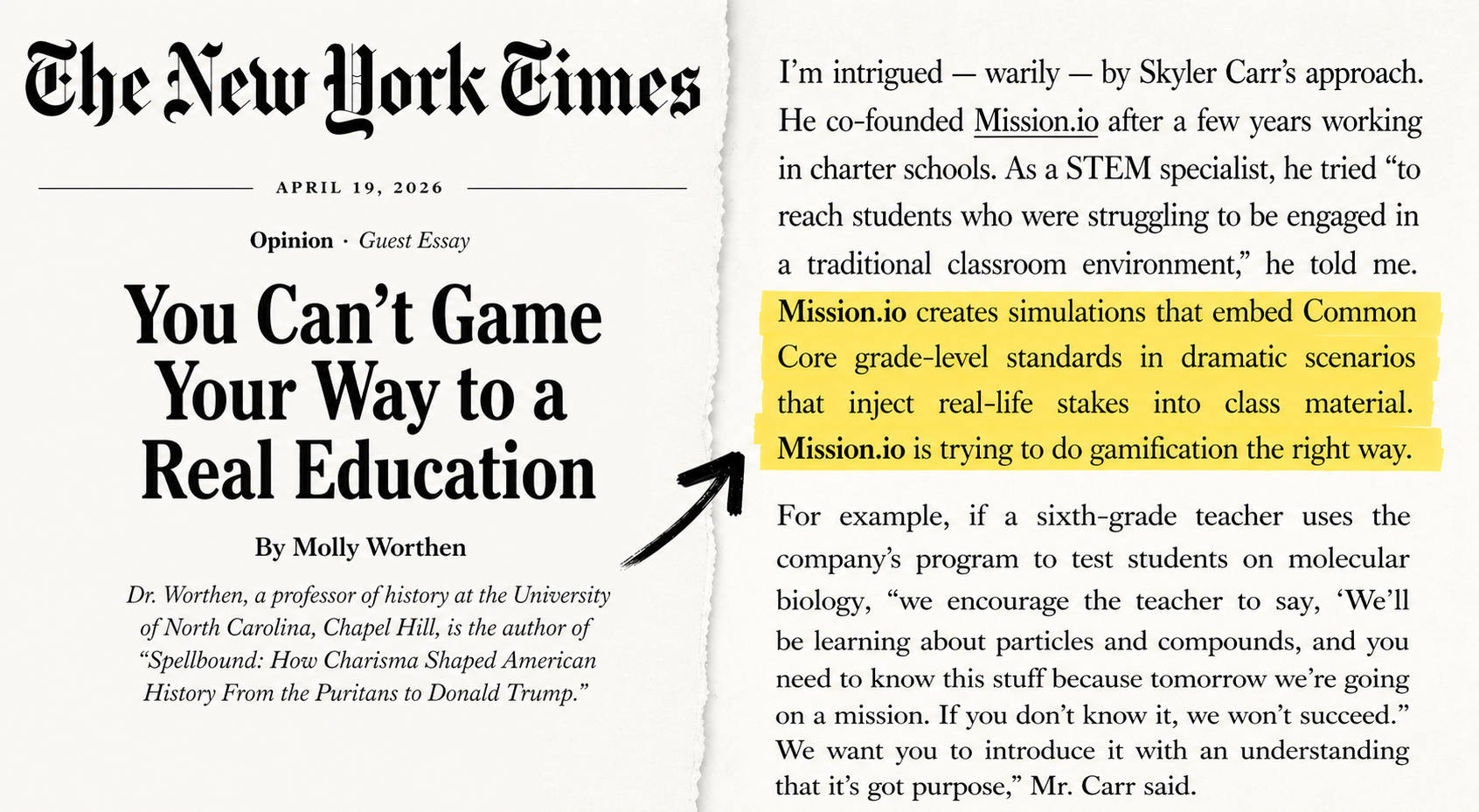
Last week the New York Times ran a deeply researched, deeply critical opinion piece on K-12 educational technology. Somewhere past the halfway point, my name shows up. "I'm intrigued — warily — by Skyler Carr's approach," the author writes.
Welcome to the club. "Intrigued, warily" is also how my mom has described me since I was about twelve. It's how every member of our team described us before they joined. It's how every investor we politely turned down described our funding model. It's how every superintendent who couldn't quite figure out what to do with a CEO of a "tech company" who spends most of his time arguing schools should buy less tech has described us. So at this point, "intrigued, warily" feels less like a critique and more like a job description.
What the article actually argues
The piece, by Molly Worthen, opens with a high school English teacher in Texas who refuses to make her class "fun" in the gamified sense, has her students hand-write essays, and won't trade Emerson and Thoreau for a video game version of Walden Pond. She is not against fun. She is against the trade most of American education has made, where stress-free amusement became the substitute for engagement.
That setup carries the rest of the piece, which boils down to a single sentence:
"This has been the greatest blunder in the past decade of K-12 education: the decision to give every child a personal computer and to gamify everything from standardized test preparation to recess."
Hard to disagree. 88% of American public schools now follow a 1-to-1 policy: one laptop or tablet for every student. In the same window, math and reading scores among 13-year-olds peaked in 2012 and have been falling ever since.
Cause and correlation get debated forever, and the article is honest enough not to pretend it has a clean line. But if you have spent any real time in classrooms, you do not need a regression to know what happened. The screens won, the kids lost, and almost no one is to blame in the way you would expect.
Procurement teams chose what looked forward-thinking at the time. Teachers, drowning in a job we have made nearly impossible, reached for the tools that got them through the day. Parents and admins fell into what I call assessment by smiles: if the kid is engaged and on-task, learning must be happening. None of those instincts are wrong on their own. They are just easier to act on than the harder question, whether a smiling, engaged kid is actually learning anything that will survive when the screen turns off. I wrote about this in more depth in our piece on screen time in schools.
The diagnosis: gamification ate the classroom
The author's sharpest section is the indictment of gamification. Not games. Games have a long, healthy history in education. The problem is what most edtech calls gamification: a thin shellac of points, badges, and confetti animations slapped onto rote content to keep kids tapping.
The piece quotes neuroscientist Jared Cooney Horvath, and this metaphor is the entire argument:
"People are mistaking kids' preference for deep biological reality. My daughter loves Popsicles. I have a choice: I could meet her where she's at and start every meal with a Popsicle. But that doesn't change the fact that, biologically, Popsicles aren't good for her, and she needs some vegetables."
We confused what kids prefer with what kids need. Then we got 8 million teachers worldwide running Kahoot games and 17 million American students on iReady, and somewhere along the way the school day quietly became a series of swipes between dopamine hits.
The most damning quote in the article comes from a speech pathologist in Rhode Island who has worked in public schools for 25 years:
"I've seen it with iReady math. They're just clicking; they want to get through it. They are not reading, because they don't really need to read. They say, 'I kind of know what they're asking, so I'll click on what I think the answer is.'"
That is not learning. That is pattern-matching against a UI. And it is a perfect description of what most "gamified" edtech actually trains kids to do.
The author connects this to a deeper problem: the skills these tools build do not survive the screen. Horvath's line should be on every superintendent's wall:
"Students get good at the game, and their score will go up, but as soon as you take them off the screen, most of those skills will go."
If a tool only produces results that exist inside the tool, what is the tool actually for? That question is the fault line in our entire industry.
The phrase the article gets exactly right: tech-intentional
In the back half, the piece introduces Emily Cherkin, "The Screentime Consultant," a former middle school English teacher who became an "accidental activist" against thoughtless tech adoption. Her line is the one I would put on a billboard:
"I'm not anti-tech. I just want schools to be tech-intentional."
That phrase, tech-intentional, is the cleanest framing of the right position I have seen in print. It is where we have been camped out for years. It is the door the author leaves open just before walking through it and finding us.
Where Mission.io enters the article
After all of that diagnosis, the article shifts. The author admits that not all gamification is the same and not all screen time is junk. They name a few exceptions. Then this paragraph, which I am going to quote in full because it does most of our marketing for us better than we ever have:
"I'm intrigued — warily — by Skyler Carr's approach. He co-founded Mission.io after a few years working in charter schools. As a STEM specialist, he tried 'to reach students who were struggling to be engaged in a traditional classroom environment.' Mission.io creates simulations that embed Common Core grade-level standards in dramatic scenarios that inject real-life stakes into class material. Mission.io is trying to do gamification the right way."
And then, walking through what a Mission actually looks like:
"On mission day, students learn that a nearby lab has suffered a dangerous chemical leak, leaving a researcher trapped. They split into teams and analyze data on airborne molecules in different parts of the lab to figure out which atom they can change to make the floating molecules nontoxic."
"But the point is to get students on their feet and moving around the classroom, sharing information and brainstorming solutions face to face. Laptops become tools for in-person collaboration, rather than private gaming consoles."
"'You can fail the mission and still get good scores on collaboration and critical thinking,' Mr. Carr said. 'That's enlightening for kids who are used to failing. It can open up their minds about how they should be working.'"
I want to pause on that last quote, because it is the line in the entire article I would most want a parent to read. The reason kids respond to Missions is not the graphics, even though our artists are very good. (The author noted that some of them came over from making skins for video games, which is officially the best recruiting bullet I have ever gotten in a national newspaper.) The reason is that for the first time in their school day, the kid who keeps failing is told something different: the mission is the test, but it is not the whole grade. How you collaborated, how you reasoned, how you stuck with a problem when the problem stuck back, those count too. Sometimes those count most.
The author closes our section by noting one more thing that sets us apart:
"Mr. Carr and his colleagues have made one decision that sets Mission.io apart from many ed tech companies: Their funding comes from foundation grants and the schools that purchase their programs. 'We had a chance to bring on investors early on, and it was an intense conversation. But we knew venture capital and the expectations,' he said. He had seen investors acquire other games and prioritize profit over education. 'We needed to be able to let schools call the shots,' he said."
Yeah. That part still keeps me up some nights. We almost took the money. The pitch was good. The check was bigger than I had ever seen. Then we read the term sheet and realized the people deciding what was good for kids would no longer be the people in classrooms with kids.
The line we hold: pro-learning, not pro-tech
Here is where I want to plant our flag, because the article gives us the room and we do not get many openings like this.
We are not a pro-tech company. We are not an anti-tech company. We are pro-learning. That is the whole stance. And it is the reason we can be brutal about edtech that is not working, including categories where we technically compete, without contradicting ourselves.
Most edtech companies cannot say that. Their incentives do not let them. If you took venture money to build a gamified math app, you cannot also be the loudest voice saying that gamified math apps are damaging kids. Your cap table will not let you. Your roadmap will not let you. Your CEO might believe it privately, but they cannot write it on a blog without their board getting on the phone.
We can. So we do.
The Three Pro-Learning Questions
Reading the NYT piece is the easy part. Knowing what to actually cut on Monday morning is harder. Here is the test we use, and what we would recommend to any school evaluating any tool, including ours.
-
Does this make my classroom more or less human?
If the tool puts every kid alone in headphones, swiping at their own screen, the answer is "less." That is the design pattern the article spends most of its energy criticizing, and it should be a no for any school that takes seriously the skills that actually shape a life. A Mission flips this on purpose. Students get out of their seats, arguing with each other about which compound to neutralize first. -
Does the skill survive when the screen turns off?
Horvath's line (as soon as you take them off the screen, most of those skills will go) is the single sharpest test we have. If a kid can pass your assessment by clicking patterns, they did not learn anything that will help them outside the app. Real learning is portable. If your tool builds a skill that only exists inside the tool, the tool is the problem. -
Who's calling the shots, the school or the cap table?
This is the one most parents never get to see, and it is the one that quietly determines what every edtech company actually optimizes for. If the company's funding model rewards engagement metrics, the product will eventually optimize for engagement metrics, no matter what the founding team intended. If the company's funding model rewards school outcomes, the product can be honest about which features to cut.
Three questions. If a tool fails any of them, you are not looking at edtech. You are looking at a screen with a worksheet on it.
What "tech against tech" actually means
The other phrase we use internally is tech against tech. We are using the same medium (screens, software, simulations) to fight the design patterns the rest of the industry is using to capture attention. Our screens exist to push kids back together. Our story exists to make standards-aligned content matter for the next twenty minutes. Our scoring exists to surface human skills that worksheets and tests have never been able to see.
You cannot fight this fight with no technology. You cannot fight it with bad technology either. You fight it with technology that is honest about what technology has done and unwilling to do it again.
That is the corner we are in, and that is why "intrigued, warily" is the most accurate description of the right reaction. Wary is the only sane starting place for any new edtech tool right now. We are not asking parents, teachers, or skeptical New York Times opinion writers to drop the wariness. We are asking them to keep it and apply it to us as hard as they apply it to anyone else.
If we cannot pass our own test, we deserve to fail it.
The closing argument: gamification cannot carry serious learning
The article ends with Emerson, which is about as on-brand for the New York Times Opinion section as a closer can get:
"Serious intellectual work and moral reasoning cannot be gamified."
That sentence is the entire reason we exist. Gamification, as the rest of the industry has practiced it, cannot carry serious learning. We agree. The work we are doing is not gamification in that sense. It is something else. It has been waiting for the rest of the conversation to get sharp enough to see the difference.
If the New York Times needed a thousand words on what edtech is doing wrong before they could spend a hundred on what one of us is trying to do differently, that is not a complaint. That is the order it had to be written in.
Intrigued, warily, is the right place to start. Welcome.
FAQ
What did the New York Times say about Mission.io?
The New York Times opinion piece on K-12 educational technology described Mission.io as a rare exception in the edtech industry, a company "trying to do gamification the right way." It walks through how a Mission works, shows how the design gets students collaborating face-to-face rather than alone in headphones, and points to Mission.io's funding model (foundation grants and schools paying directly, no venture capital) as what lets the company prioritize learning over engagement metrics. The full quote and context is in the original article.
What is the New York Times article about edtech actually arguing?
The piece argues that the past decade of K-12 educational technology, including 1-to-1 laptops, gamified apps, and screen-based instruction, has been a major mistake, and that test scores, attention spans, and reading comprehension have all suffered as a result. It is not anti-technology. It is pro tech-intentionality, which means choosing technology with a clear instructional purpose rather than defaulting to it because it feels modern.
What is Mission.io and how is it different from other edtech?
Mission.io is a whole-class, collaborative instructional experience where students work together through live, story-driven Missions to solve meaningful academic problems. Unlike most edtech, students are not alone with their screens. They are out of their seats, working as a team to apply standards-aligned knowledge to a high-stakes scenario. Mission.io is funded by schools, foundations, and federal research grants, not venture capital, which is part of why the New York Times article highlighted it as an exception.
What does "pro-learning, not pro-tech" mean?
It means the company exists to advance learning, not technology adoption. We use technology only when it makes a classroom more human, builds skills that survive outside the screen, and lets schools, not investors, call the shots. We are willing to publicly criticize edtech tools that do not meet that bar, including in categories where we compete. That stance only works if your funding model lets you say it out loud.
Why is gamification controversial in education?
Most "gamification" in edtech is points, badges, and animation layered onto rote content. Research suggests this kind of design captures attention without producing skills that transfer off the screen. The New York Times article quotes a neuroscientist arguing that "computers are wickedly narrow," meaning students get good at the game but the skill rarely generalizes. Real game-based learning, where games drive collaboration and struggle through real problems, is something different and far rarer.