Program
Funding Type
Allowable Uses
How Mission.io Qualifies
Title I, Part A

Formula funds allocated by the U.S. Department of Education to states and then to LEAs based on counts of low-income students
Academic improvement, evidence-based interventions for at-risk students
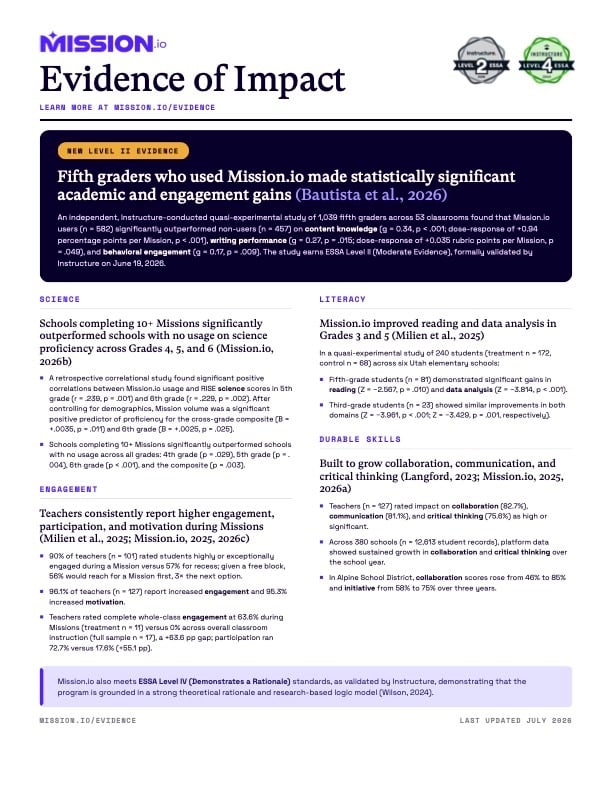
Mission.io provides evidence-based digital learning activities associated with increased behavioral engagement, content knowledge, and writing proficiency (Bautista et al., 2026) and reading and data analysis (Milien et al., 2025). It supports Title I school-wide and targeted assistance programs by building academic skills across content areas, increasing student engagement, and developing collaboration and critical thinking through interactive Missions.
Title II, Part A
Formula funds distributed by states to LEAs based on enrollment and poverty levels
Teacher effectiveness, professional learning
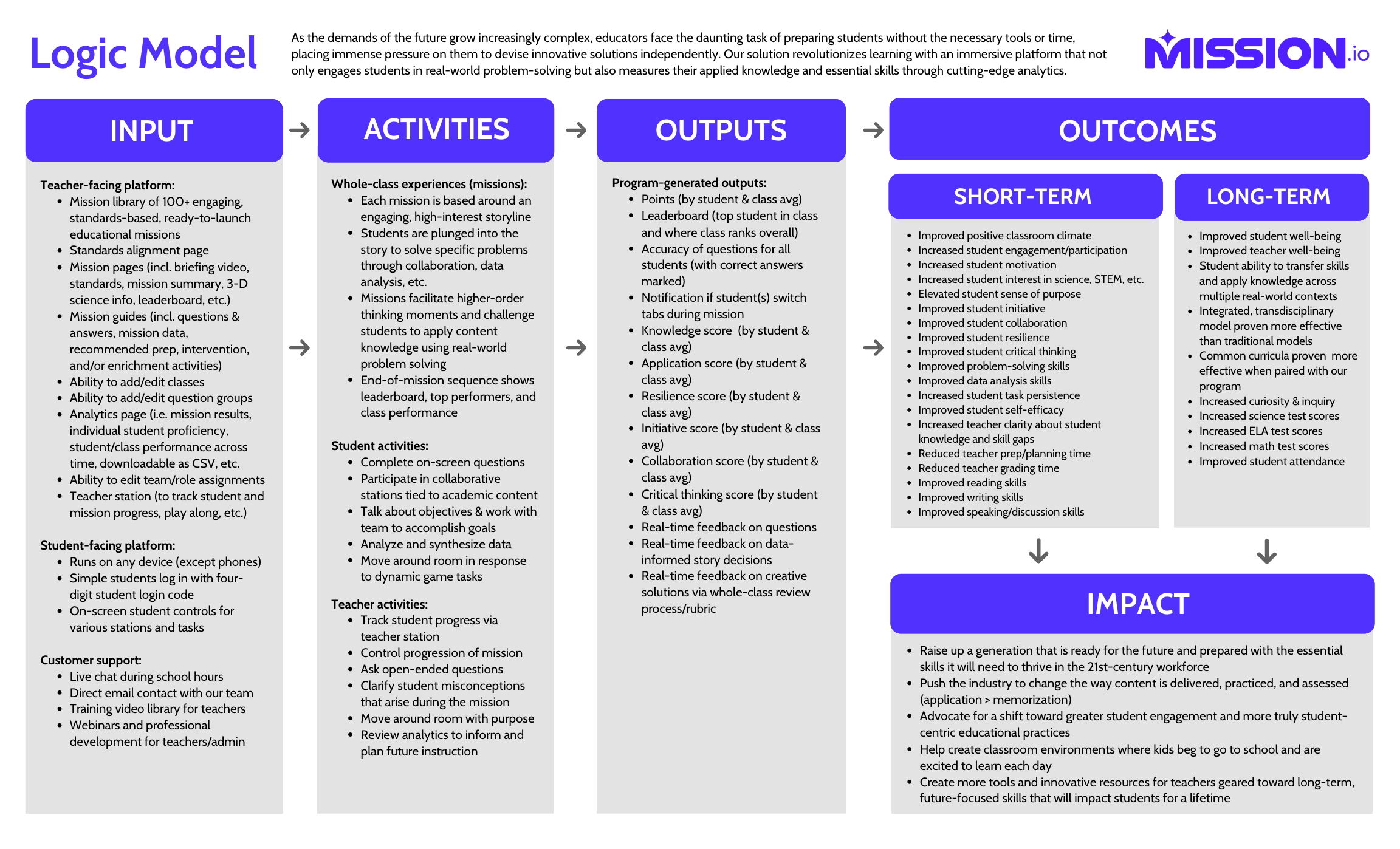
Mission.io enhances teacher practice with teacher-led, whole-class experiences, real-time dashboards, actionable analytics, and formative data that inform instruction and intervention. The program supports PD goals by strengthening teachers’ ability to engage students in inquiry-based, standards-aligned instruction and by promoting reflective teaching practices aligned with educator effectiveness frameworks.
Title III, Part A
Formula funds allocated to states based on English Learner enrollment, then sub-granted to eligible districts
English Learners, academic language
Missions embed academic vocabulary, communication, peer discussions, and content-area literacy. English Learners practice reading for meaning, collaborating with peers, and applying academic language in context. This aligns with Title III objectives to promote English proficiency and access to rigorous, content-rich instruction.
Title IV, Part A
Formula funds allocated by the U.S. DOE to states and then to LEAs
Well-rounded education, safe and healthy students, effective use of technology
Mission.io supports all three Title IV-A priority areas: (1) Well-rounded education through integrated cross-curricular Missions; (2) Safe and healthy students through teamwork, resilience-building activities, and Missions that help teachers develop a positive classroom climate; and (3) Effective use of technology via an accessible, standards-aligned digital platform.
Title IV, Part B
Competitive grants awarded by the state education agency to eligible applicants (districts, schools, or community partners)
Academic enrichment opportunities during non-school hours, including after-school, before-school, and summer programs
Mission.io aligns with 21st CCLC objectives by extending academic and character development beyond the school day. Our ready-to-run, story-based Missions strengthen literacy, data reasoning, and STEM skills while fostering collaboration, leadership, and resilience. Districts and community partners can integrate Mission.io into enrichment rotations, STEM clubs, after-school programs, and/or summer programs using existing sub-grants or future 21st CCLC competitions, making it a flexible, high-impact enrichment solution.
.png?width=141&height=141&name=ESSA%20Level%20II%20Evidence%202026%20(1).png)
.png?width=146&height=146&name=ESSA%20Level%20IV%20Evidence%202024%20(1).png)
Evidence Base and ESSA Alignment