Best NGSS Science Curriculum (2026)


Introduction

Choosing an NGSS science curriculum is one of the highest-stakes instructional decisions a district makes. You’re not just selecting materials. You’re committing to a multi-year implementation, a professional learning system, and an instructional philosophy that will shape science education across your schools. No pressure.

This guide provides a structured comparison of the most widely adopted NGSS programs, built for the people who actually have to make this decision and live with it.

If you’re searching for the “best” NGSS science curriculum, you’re asking the wrong question. The better question is:
Which program fits our instructional model, our operational capacity, and our district’s implementation readiness?

  
Section II

Who this guide is for

This comparison is built for the people who carry the actual weight of this decision: district science supervisors, curriculum directors, instructional coaches, school leaders, and teachers who know they’re going to have to teach this material five days a week.

If you’re comparing programs before adoption, or re-evaluating something that isn’t working, this guide will help you cut through the noise.

Section III

Programs included in this comparison


We compare 11 widely adopted NGSS-aligned programs across the same criteria, so you’re not bouncing between vendor sites trying to piece together a side-by-side view:

Each program is evaluated across five criteria: primary strength, best fit, implementation complexity, assessment infrastructure, and hands-on intensity.

For detailed breakdowns, see the individual curriculum review pages linked below.

  
Section IV

How to compare NGSS science curriculum programs

Vendor alignment charts tell you whether a curriculum claims to address standards. They don’t tell you how teaching actually feels when you’re running it on a Tuesday in February.

Five criteria drive every comparison in this guide:

  • Primary strength: the instructional model and design philosophy each program is built around
  • Best fit for: the district contexts, teacher profiles, and implementation conditions where each program tends to perform well
  • Implementation complexity: the operational, logistical, and professional learning demands each program places on teachers and administrators
  • Assessment infrastructure: the built-in tools for monitoring student progress and reporting standards mastery
  • Hands-on intensity: the frequency and depth of lab work, investigation cycles, and engineering design activity

Comparing programs across the same criteria makes the real tradeoffs visible, not just the ones vendors choose to highlight.

  
Section V

Implementation complexity: what it actually means

Two curricula can look identical on paper and differ dramatically in what they ask of teachers, teams, and budgets.

What drives implementation complexity:

  • Materials rotation and storage requirements
  • Consumables management
  • Technology infrastructure
  • Teacher onboarding and professional learning
  • Pacing clarity across grade levels
  • Data reporting systems

Districts that evaluate implementation lift before signing a contract tend to have noticeably smoother adoptions.

For a step-by-step framework, see our Curriculum Adoption and Implementation Guide.

  
Section VI

At-a-glance comparison of major NGSS curricula

Primary Strength
Best Fit For
Implementation Complexity
Assessment Infrastructure
Hands-On Intensity
Literacy + modeling routines
Districts prioritizing literacy across the curriculum
Moderate – requires consistent facilitation of routines
Embedded formative tasks + centralized digital reporting
Moderate – blended simulations with structured investigations
Sustained phenomenon inquiry; open-license (free)
Strong facilitation cultures; districts with limited budgets
Moderate–High – teacher-led discourse; minimal centralized system controls
Primarily teacher-managed formative assessment
High – frequent investigation cycles embedded within storylines
Investigation-centered labs
Schools prioritizing tactile experimentation
Moderate – significant materials rotation, storage planning, and consumable tracking required
Teacher-managed assessment tools
Very High – extensive hands-on lab sequences supported by kits
Structured 5E + dashboards
Large-scale district rollout
Low – centralized pacing reduces variability; implementation supported by digital infrastructure
Centralized digital reporting + benchmark tools
Moderate – structured investigations within 5E framework
Platform scalability
Multi-campus consistency
Low – designed for streamlined rollout with centralized tools and structured pacing
Strong centralized dashboards and reporting
Moderate – balanced lab work and digital interaction
Streamlined digital delivery
Districts prioritizing rollout efficiency
Low – digital-first structure reduces materials management and logistical lift
Centralized digital reporting
Moderate – investigation activities supported by digital resources
Simplicity and accessibility
Elementary classrooms with limited science blocks
Low – minimal materials management; short lesson format reduces rollout friction
Limited formal reporting infrastructure
Moderate – simple hands-on tasks with low materials burden
Multimedia library
Device-rich districts
Low – implementation dependent on digital infrastructure rather than materials logistics
Strong centralized dashboards
Moderate – digital simulations supplemented by investigations
Balanced 5E + simulations
Hybrid digital/inquiry environments
Moderate – requires coordination of digital and physical components
Embedded assessments with reporting tools
High – inquiry labs combined with digital reinforcement
Concise digital instruction
Blended learning models
Moderate – flexible structure requires teacher pacing management
Embedded digital assessments
Moderate – targeted investigations within short lesson cycles
Engineering design challenges
Schools emphasizing applied STEM
Moderate – requires scheduling flexibility and coordination of materials
Limited centralized reporting; performance-task driven
High – extended project-based and design-focused challenges
  
Section VII

Individual NGSS science curriculum reviews

The table above shows structural differences. The pages below go even deeper: instructional model, implementation complexity, cost structure, assessment infrastructure, and head-to-head comparisons with competing programs.

Amplify Science
Amplify integrates scientific modeling, structured discourse, and evidence-based writing into repeatable daily routines. The curriculum blends digital simulations with hands-on investigation and is often evaluated by districts that want literacy integration built into science, not added on top of it.

OpenSciEd
OpenSciEd is a freely available, phenomenon-driven curriculum released under a Creative Commons license and available for download at openscied.org. The complete K–8 curriculum was finalized in early 2026. Instruction is organized around sustained storylines in which students develop and revise explanations over extended arcs. Implementation demands strong teacher facilitation and comfort with open-ended inquiry.

FOSS
FOSS centers instruction on hands-on investigation cycles supported by well-stocked materials kits. It’s a strong fit for districts that prioritize tactile science and are prepared to manage the materials logistics that come with it.

Inspire Science (McGraw Hill)
Inspire Science follows the structured 5E instructional framework with centralized pacing and digital reporting tools. It’s built for large-scale district rollout and is frequently evaluated by districts that need consistency across many campuses.

HMH Into Science
HMH Into Science combines sequenced instruction with a centralized digital platform. Embedded assessments and reporting dashboards give administrators visibility into standards alignment and student performance across schools.

Savvas Experience Science
Savvas Experience Science delivers NGSS-aligned instruction through a digital platform designed for streamlined access and pacing. Its structure reduces logistical complexity, which makes it a practical choice when rollout efficiency is the priority.

Mystery Science
Mystery Science offers short, video-anchored lessons built around compelling scientific questions. It’s designed for accessibility and requires fewer materials logistics than kit-heavy programs, which is why it’s commonly used in elementary settings with limited science time.

Discovery Education Science Techbook
Discovery Education Science Techbook integrates multimedia resources, simulations, and assessments in a single digital platform. Centralized dashboards support district-level monitoring. It works best where device access and digital infrastructure are solid.

STEMscopes
STEMscopes follows a 5E instructional sequence supported by digital simulations and inquiry-based labs. The curriculum blends hands-on investigation with online reinforcement and gives teachers meaningful flexibility in pacing.

Twig Science
Twig Science delivers NGSS instruction through concise, media-supported digital lessons. It’s built for blended learning environments and integrates targeted investigations within short-form instructional content.

Project Lead The Way (PLTW)
PLTW emphasizes engineering design challenges and applied STEM problem solving. Students work through structured projects requiring collaboration and iterative refinement. It’s often positioned as a complement to a core science curriculum rather than a standalone replacement.


Section VIII

What keeps any curriculum from losing students

Every program in this comparison is well-designed. Every one of them also faces the same implementation challenge over time: engagement erodes.

That’s not a flaw in any specific curriculum. It’s how structured instructional programs work. Once students and teachers know the routine, familiarity sets in. Lesson cycles become predictable. Students learn the pattern of the curriculum rather than grappling with the science inside it. Teachers are covering the material but students are learning it less reliably than the pacing guide assumes.

This is one of the most consistent patterns in NGSS implementation, and it shows up regardless of which program a district adopts. The curriculum isn’t the problem. The absence of collaborative, engaging application experiences is.

The districts that get the most from their curriculum investment tend to address this directly. They supplement their core program experiences that give students regular opportunities to actually use the science they are learning in engaging and meaningful ways. When students work through problems that require reasoning, collaboration, and genuine decision-making, teachers can see in real time who understands the content and who needs more support before the unit ends.

Structured supplementation with programs like Mission.io are designed to provide this application layer inside any NGSS curriculum. Mission.io is a K–8 program that embeds collaborative, standards-aligned challenges at defined instructional moments. Students apply core content to a problem that requires real thinking. The core curriculum provides the instructional foundation. Structured supplementation gives that learning a regular place to be applied and tested.

  
Section IX

The honest bottom line

There is no perfect NGSS science curriculum. There is only the one that fits your district, your teachers, and your students.

The comparison table shows structural differences. The individual reviews unpack the tradeoffs. The implementation guide helps you plan for what happens after you sign the contract. And structured supplementation ensures that even a well-chosen curriculum doesn’t lose students somewhere between the lesson and the learning.

Before you decide, ask three questions:

  • Does this model match how our teachers actually teach?
  • Can we sustain what it asks of us, logistically and professionally?
  • Will our students regularly have to apply their learning in ways that require real thinking?

When those three things align, adoption becomes sustainable.

  
Section X

Resource Hub

From the blog

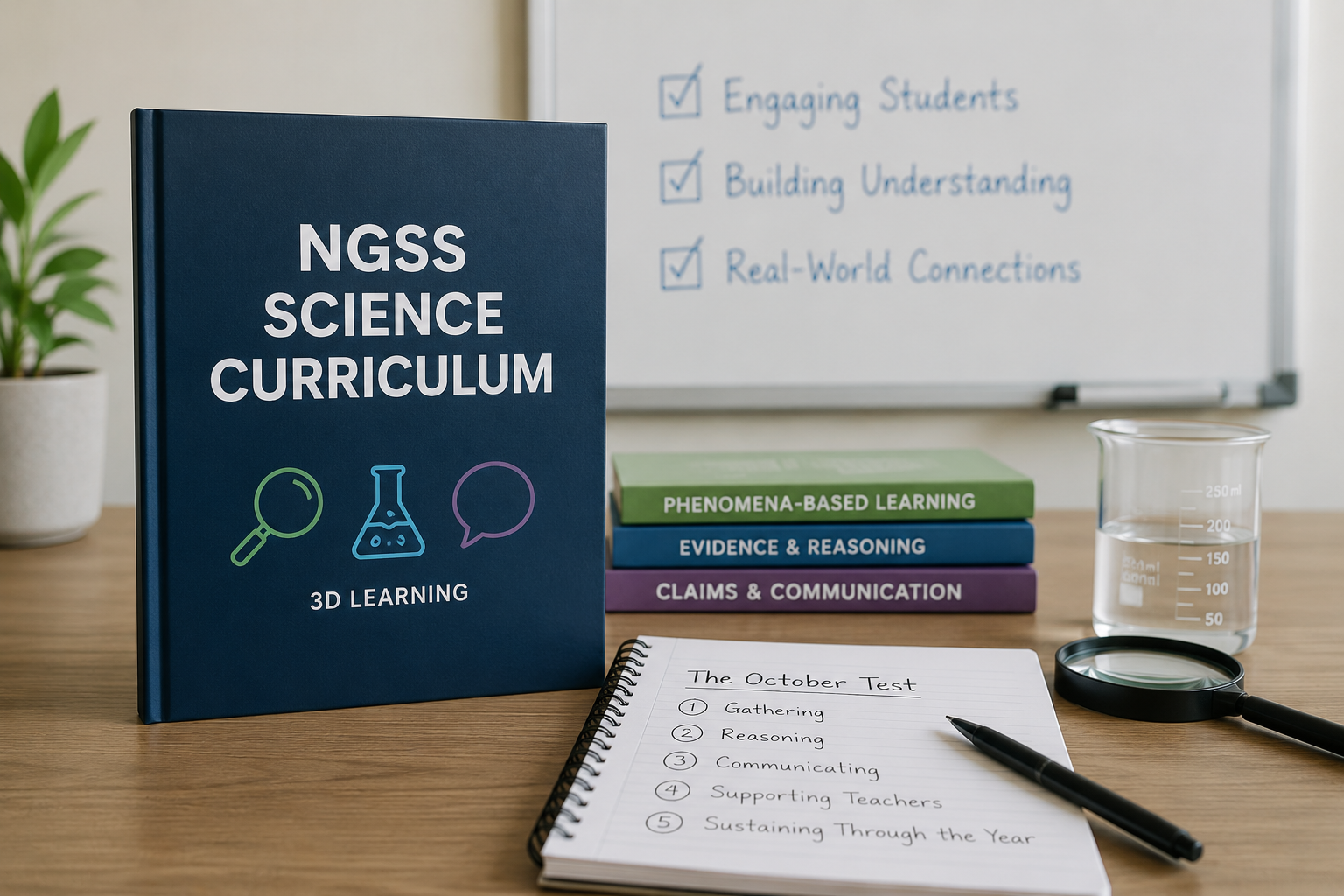
How to Choose the Right NGSS Science Curriculum (Without Regretting It in October)
Stack of NGSS curriculum options.

How to Choose the Right NGSS Science Curriculum (Without Regretting It in October)

9 min read
Switching Science Curriculum? A Realistic Guide for Classroom Teachers

Switching Science Curriculum? A Realistic Guide for Classroom Teachers

8 min read
  
Section XI

Frequently asked questions

What is the best NGSS science curriculum?

There isn’t one. The right program depends on your district’s instructional priorities, materials capacity, digital infrastructure, professional learning readiness, and long-term implementation goals. Programs that thrive in one context struggle in another.

Which NGSS curriculum is most straightforward to implement

Curricula with centralized pacing and digital dashboards, such as HMH Into Science, Inspire Science, and Savvas Experience Science, tend to be more straightforward to roll out at scale. That said, a smooth rollout and effective implementation aren’t the same thing.

Which NGSS curriculum is most hands-on?

FOSS, STEMscopes, and Project Lead The Way place the heaviest emphasis on hands-on labs and engineering design. These programs deliver highly tactile science instruction but require stronger materials logistics to support them.

How do you compare NGSS science curriculum programs?

Look past alignment charts. Evaluate instructional structure, three-dimensional integration, assessment infrastructure, materials logistics, and implementation complexity. The most useful question is: what does it actually require to teach this well?

Are open-license NGSS curricula free?

Open-license curricula like OpenSciEd don’t require licensing fees for core materials. But implementation still involves real costs: printing, materials sourcing, professional learning, and ongoing support. Free licensing rarely means free implementation.

How long does NGSS implementation take?

Plan for multiple years. Most districts spend year one piloting, year two rolling out, and years three and beyond refining professional learning and cross-campus consistency.

Can NGSS curricula be supplemented?

Yes. Many districts add structured application experiences to reinforce standards, deepen collaboration, and maintain instructional momentum without replacing the core program. Mission.io is one of the most popular and powerful NGSS supplements available.

Back to top