
Share this
by Skyler Carr on May 29, 2026
TL;DR: Most NGSS curriculum regret has a season, and it's October. The materials looked great in the spring demo, then quietly went flat once the novelty wore off. The fix is to stop evaluating curricula on what their alignment charts promise and start evaluating them on what they actually make students do on an ordinary day. This guide gives you a five-question gut check, The October Test, built on the look-fors that define strong three-dimensional science instruction.
Most NGSS curriculum regret has a season. It's October.
The decision got made in spring. The demo was sharp, the binder was beautiful, the rep answered every standards question without blinking. You signed. Summer training went fine. And then somewhere around mid-October, you walk into a fifth-grade room expecting to see students figuring something out, and instead you see twenty kids quietly filling in the same kind of worksheet they were filling in under the old program, just with a nicer logo at the top.
The curriculum didn't break. It did exactly what it was built to do. You just bought it for the wrong reason.
Here's my conflict of interest, stated plainly, because you should know it before you take a word of this seriously: I run a company, Mission.io, that a lot of districts buy alongside a new science curriculum. So I have a reason to want to be in this conversation. What I don't have is a reason to want you to pick any particular program. We take no referral fees, no kickbacks, no co-marketing money from Amplify, OpenSciEd, FOSS, or anyone else on the list. Not one of them pays us a cent, and we'd tell you if they did.
What we have instead is a strange amount of hours. Because districts kept adopting us next to their core program, we had to learn all of these curricula cold, not from the sales decks but from the inside, the way they actually run in November when the kits are half-restocked and a sub is covering third period. The opinions here are bought with that time, not with anyone's marketing budget. Take them or leave them.
Why a good curriculum still disappoints you in October
Start with the thing nobody selling you a curriculum will lead with: every serious NGSS program is aligned. Alignment is the floor. It is the price of being on your shortlist at all, not the thing that separates the winners from the regrets.
What actually decays over a school year isn't alignment. It's whether students are doing science or performing a routine. Every structured program faces this, regardless of the publisher. Once teachers and students learn the pattern of the curriculum, familiarity sets in, the lesson cycle becomes predictable, and kids get very good at the choreography of the program while grappling less and less with the science inside it. The pacing guide says they're learning it. The October walkthrough says something quieter.
This is the part an alignment review can't tell you. A standards chart confirms a curriculum claims to address a performance expectation. It says nothing about how teaching that performance expectation feels on a Tuesday in February, which is the only time that actually counts.
The October Test: five questions to ask before you sign
There's a one-page checklist that good districts use to evaluate science lessons. It lists what you should be able to see in a strong three-dimensional lesson, sorted into three phases: students gather information, students reason from evidence, students communicate and defend their thinking. Observe the noise, the friction, the kid arguing about a data table. These are the "Look-Fors", and they are the highest-impact teacher practices in science instruction.
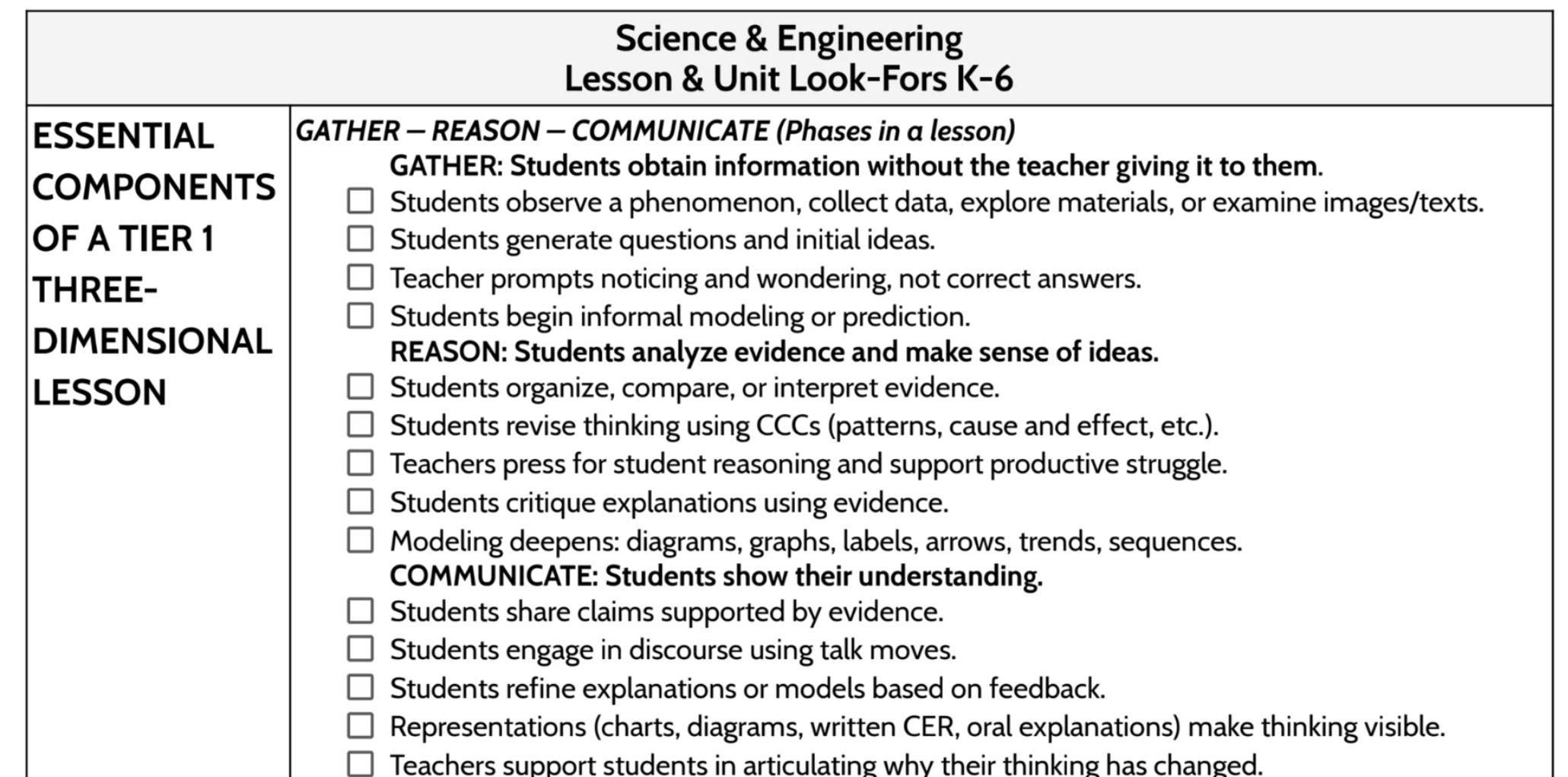
Most evaluation rubrics ask whether a curriculum can produce those behaviors. The better question is whether it will still produce them in October, when the new-curriculum smell is gone. That's The October Test. Five questions. Run any program you're considering through all five.
1. In October, are students still gathering, or has the teacher gone back to telling?
The first look-for in any strong lesson is students obtaining information without an adult handing it to them. Observing a phenomenon. Collecting data. Wondering out loud before anyone confirms they're right. Some programs protect that instinct all year. Others quietly collapse back into the teacher narrating the answer because that's faster, and the curriculum lets them. Ask to see month-three lessons, not the showcase unit.
2. Are students reasoning from evidence, or recalling the steps of a routine?
A program survives this question when students are organizing, comparing, and interpreting evidence, then revising their thinking when the evidence pushes back. A program fails it when "reasoning" has become a worksheet shaped like reasoning. The tell is productive struggle. If you can't find a moment where students are genuinely stuck and working through it, you're looking at recall in a lab coat.
3. Do students still have to defend a claim out loud, or has discourse quietly died?
Communicating understanding means students share claims backed by evidence, argue with each other using real talk moves, and refine what they think after someone pushes on it. This is the first thing to disappear under time pressure, because discourse is loud and slow and hard to schedule. Ask the question directly: in this program, in week twelve, is anyone still required to convince a peer they're right?
4. Does the model survive a normal Tuesday in February?
Every curriculum works in the demo. The question is what it asks of a real teacher on a normal day, mid-unit, no extra prep, a sub plan nobody read, half the materials kit where it's supposed to be. Programs with deep daily prep demands or heavy materials logistics can be excellent and still buckle under ordinary conditions. Evaluate the implementation lift, not just the design.
5. Will you see the skills, or just the score?
The Look-Fors are about behavior: collaboration, reasoning, the willingness to defend an idea. Most assessment infrastructure measures none of that. It tells you who completed the task, not who understood the science or who carried their group. Before you adopt, ask what the program lets you actually see. If the only evidence it produces is a score, you'll find out who was really doing science about a unit too late to help them.
Why this is the bar, and why we hold ourselves to it
Underneath all five questions is one belief, and it's the reason I care about this enough to write a small sermon on it: science only becomes a skill when a student has to use it.
A lesson teaches science. An experience makes a student practice it, under conditions where knowing the right answer isn't enough and they have to apply it with other people to get somewhere. That distinction is the whole game. The stretch it takes to turn a science lesson into a science experience is, in my experience, always worth it, because that is how content turns into a durable skill instead of a fact that evaporates after the test. It's also how you prepare a kid for a future where knowing things matters less every year and being able to do something with what you know matters more.
I'll be straight that this is exactly the thing Mission.io is built to do, every single time, on purpose. But I'm not making that point to sell you. I'm making it because it's the standard the Look-Fors describe, and it's the standard you should hold any program you adopt against, ours included.
Run the test: Amplify vs. OpenSciEd
Watch how this changes the most common adoption decision in the country right now: Amplify Science or OpenSciEd.
The usual way that conversation goes is a standards bake-off and a budget argument. Both are well-aligned, so the standards chart is close to a tie. OpenSciEd is open-license and Amplify isn't, so the budget conversation is loud. And districts pick on price and pretend they evaluated instruction.
Now run The October Test instead. Amplify is built on repeatable daily routines, which is a real gift to a first-year teacher and a real risk by October, because the same structure that scaffolds delivery is what veteran teachers describe as predictable once students learn the pattern. OpenSciEd is the opposite trade: its storyline model can hold genuine inquiry over weeks, but it assumes a teacher who can sustain that without prescribed daily steps, plus serious prep time. Question 4 (does it survive a normal Tuesday) and Question 1 (are students still gathering, not being told) sort these two programs faster than any price-per-seat spreadsheet. The right answer depends entirely on your teachers, which is the point. There is no best curriculum. There's only the one that keeps passing the test in your building.
That's the level the full NGSS curriculum comparison is built to support, and it's why every review on it leads with how a program actually runs, not how it markets.
The part most districts learn the hard way
Here's the honest bottom line, and it's the one piece of this that's uncomfortable for everyone, us included. No curriculum, chosen perfectly, passes The October Test forever on its own. The erosion is structural. It happens to good programs run by good teachers, because predictability is what structured programs are for.
The districts that keep passing the test tend to do one thing on purpose: they give students a regular, built-in place to actually use the science they're learning, in a setting that demands reasoning, collaboration, and a real decision. That's the category we're in, so I'll say it once and move on. In our Spring 2025 survey, 97% of teachers reported increased student excitement on Mission days (n=127, teacher-reported). And in Alpine School District, elementary schools where students completed ten or more Missions in a year showed higher state science proficiency than schools with no usage, a correlational finding, not a causal one (Mission.io, 2026). More than a million students have run a Mission, and the work is backed by the National Science Foundation, the Institute of Education Sciences, and the U.S. Department of Education. If you want the receipts before you believe a word of it, here they are. And if you want to see how it actually works in a classroom, that's there too.
That's the entire pitch. Not "replace your curriculum." Add the layer that keeps a good one from going quiet in October.
The point
A curriculum you regret in October is rarely a bad curriculum. It's usually a good one you chose for the wrong reason, on a spring afternoon, against a standards chart that was never going to tell you what a Tuesday would feel like.
A curriculum's alignment chart tells you what it promises. October tells you what it does. Pick the program that still makes students gather, reason, and defend an idea when no one's watching and the novelty's long gone, and October stops being a verdict. It just becomes another good month of kids doing science.
Frequently asked questions
How do I choose the right NGSS science curriculum? Start by treating alignment as a baseline, not a differentiator, since every serious program clears it. Then evaluate what each program actually makes students do months into the year: gather information themselves, reason from evidence, and defend claims out loud. The most useful question isn't "is it aligned," it's "what will this require to teach well in February, and will I be able to see whether students are really learning?"
What's the most common reason a new NGSS curriculum disappoints? Engagement erosion. Once teachers and students learn the pattern of a structured program, the lessons become predictable and students get good at the routine while grappling less with the science inside it. This happens to well-designed programs regardless of publisher. It's not an alignment problem. It's the absence of regular, demanding application that keeps students actually using what they learn.
Is an NGSS-aligned curriculum enough on its own? Alignment confirms a program addresses the standards. It says nothing about whether students will still be reasoning and collaborating later in the year, or whether you'll be able to see those skills when they do. Many districts pair a strong core curriculum with structured application experiences so students regularly apply content under conditions that require real thinking, and so teachers can see who understands it.
How do I know if a science curriculum is truly three-dimensional? Look past the alignment chart at observable behavior. In a strong three-dimensional lesson, students obtain information without being told the answer, analyze and interpret evidence, revise their thinking using crosscutting concepts, and communicate claims they have to defend. If a program produces those behaviors in a normal mid-year lesson and not just the showcase unit, it's genuinely three-dimensional.
Should we supplement our core science curriculum? Often, yes. The goal isn't to replace a well-chosen core program, it's to add the application layer that structured curricula tend to under-deliver over time: regular, collaborative challenges where students use the science to make a real decision. That sustains engagement and gives teachers visibility into reasoning and collaboration that worksheet-based assessment was never designed to capture.