Winter Science Activities for Grades 3-8, Minus the Glitter
Skyler Carr
Skyler Carr is the CEO of Mission.io and a former STEM specialist.
TL;DR: The best winter science activities start with something students can see out the window, like frost, snow, early sunsets, and storms, and make them explain it. Below are winter science activities for grades 3-8, each paired with an NGSS-aligned Mission, plus the Cold Case Method: a four-step way to turn any winter lab into real science instead of a craft. Updated November 2026.
Every December, the internet runs out of science and fills the gap with glitter. Snowflake slime. Melting snowmen. Fake snow from a diaper. Search “winter science activities” and you’ll find a hundred of them, many of them written for preschoolers, and almost all of them end with the same move: the teacher already knows what happens, the kids watch it happen, and everyone goes to lunch.
Here’s where I’m coming from: I was a STEM specialist before I ran a company, so I’ve lived the December schedule. Assemblies, half days, concerts, and a class that has mentally left for break by the 15th. You need something that holds a room for forty minutes. I get the glitter.
But winter is the one season when the phenomenon is literally outside the window. Kids see their breath on the way to the bus and watch it get dark before dinner. That’s not a reason to do crafts. That’s the best setup for real science you’ll get all year.
Why most winter science activities are snow-globe science
I call it snow-globe science. It looks beautiful, it gets shaken up for a minute, and nothing gets in or out. No real question goes in at the start. No thinking comes out at the end. The kids remember the slime. They don’t remember why it did what it did.
Keep the hands-on stuff. Hands-on is great. Just stop handing students the answer before they’ve had a chance to want it. The Next Generation Science Standards are built around exactly that: start with a phenomenon, then make students explain it. Winter just happens to deliver the phenomena for free.
“In winter, the science lab is the parking lot. Use it.” (Skyler Carr, CEO of Mission.io)
The Cold Case Method: 4 steps to turn any winter activity into real science
Treat every winter activity like a cold case. Somebody saw something strange. Your class has to figure out what happened, and they have to prove it.
1. Open the case
Start with something students have actually seen this week. “Why was there frost on the car this morning but not on the road?” works better than any slide. If they’ve seen it, they already have a theory, and a kid with a theory is a kid who wants to know if they’re right.
2. Get a statement on record
Before anything happens, every student writes down what they think will happen and why. One sentence is enough. This is the step everyone skips, and it’s the one that makes the rest matter. You can’t be surprised by a result you never predicted.
3. Work the evidence
Now do the hands-on part: the experiment, the measurement, the observation. Students are testing their own statement, so they’re watching for something specific.
4. Close the case
Students argue it out: what they claimed, what the evidence showed, and why the evidence supports one explanation over another. If you already teach claim, evidence, reasoning, this is the same move with snow on its boots. The case is closed when someone can explain it to a classmate who disagreed.
Winter science activities by grade
Every activity below runs as a Cold Case and pairs with a Mission at the same standard, so you can do the hands-on piece one day and let the class apply it in a Mission the next.
Grades 3-4
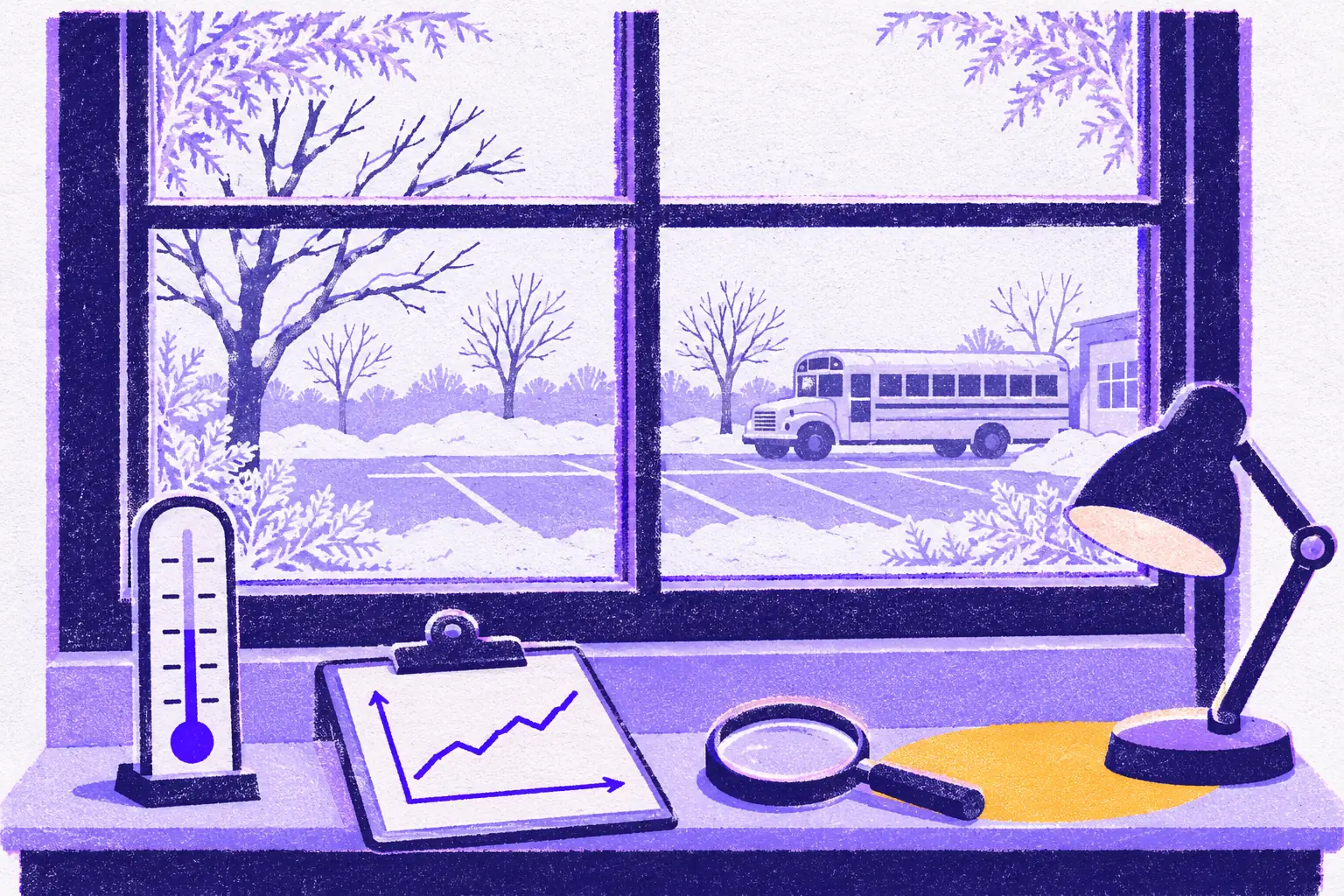
The case of the frozen bus stop. Why was it below freezing at the bus stop and well above it by lunch? Have students record the temperature at the same two times every day for two weeks and graph it as a class. Then let them predict what the graph will look like in March. This pairs with Melting Point (3-ESS2-1, 3-ESS2-2, 41 minutes), where the class works through weather by season and climates around the world. More third grade options are on the 3rd grade science activities page.
The case of the exploding pothole. Why do roads crack after a cold snap? Fill a small plastic container to the brim with water, cover it loosely with foil, and freeze it overnight. By morning the ice has pushed the foil up, because water expands by about 9 percent as it freezes. Now ask what that does to water sitting inside a crack in the road. Pair it with Landslide (4-ESS2-1, 38 minutes), which covers weathering and erosion by water, ice, wind, and plants.
Grade 5
The case of the 5 p.m. sunset. Why is it dark before dinner? Do the shadow-tracking activity on the winter solstice (Monday, December 21, 2026): trace the shadow of a stick at the same three times of day, then compare it to the shadows you traced in September if you have them. The noon shadow is the longest of the year. Pair it with Operation Starfall (5-ESS1-1, 5-ESS1-2, 40 minutes), on shadows, day length, and the seasons.
The case of the shrinking snow. Pack a clear cup with fresh snow, mark the level, and have everyone predict where the water line will land after it melts. Most kids guess way too high. A common rule of thumb is about ten inches of snow to one inch of water, and it swings a lot from storm to storm. Then weigh a sealed bag of snow before and after it melts to show the mass doesn’t change. That’s two standards in one cup. Pair it with Hydro Heist (5-ESS2-2, 34 minutes), on where Earth’s water is (more than two-thirds of Earth’s fresh water is frozen in ice caps and glaciers, according to the USGS), or with Matter Matters (5-PS1-2, 47 minutes) for conservation of matter. Find more on the 5th grade science activities page.
Grades 6-8
The case of the visible breath. Why can you see your breath in December and not in May? Run frost in a can: fill a metal can with crushed ice and a few spoonfuls of salt, stir, and wait. Salt lowers the temperature the ice melts at, so the mixture gets colder than 0°C, and water vapor from the room turns straight into frost on the outside of the can. Students have to explain where the frost came from. It’s the same idea as your breath on a cold morning: water vapor loses thermal energy and changes state. Pair it with The State of Things (MS-PS1-4, 40 minutes), on what adding or removing thermal energy does to particles, temperature, and state.

The case of the forecast that was right. How did the forecast see the first big storm coming days ahead? Pull up a weather map from the last storm and have students track where the cold air and warm air met. Pair it with Storm Front (MS-ESS2-5, 16 minutes), a short Mission on how colliding air masses change the weather. It fits in a shortened December period.
The case of the blinding snow. Why does fresh snow hurt your eyes on a sunny day? Shine a flashlight on white paper, black paper, foil, and wax paper, and have students measure what bounces back with a light meter app. Then connect it to snow, which reflects most of the sunlight that hits it. Pair it with Cold Dark Planet (MS-PS4-1, MS-PS4-2, 34 minutes), on wave energy and how materials affect light. More on the 7th grade science activities page.
At a glance
| Grade | The case | Hands-on activity | Mission | Standard |
|---|---|---|---|---|
| 3 | The frozen bus stop | Two-week temperature graph | Melting Point | 3-ESS2-1, 3-ESS2-2 |
| 4 | The exploding pothole | Freeze a full container overnight | Landslide | 4-ESS2-1 |
| 5 | The 5 p.m. sunset | Solstice shadow tracking | Operation Starfall | 5-ESS1-1, 5-ESS1-2 |
| 5 | The shrinking snow | Melt a cup of snow, weigh a sealed bag | Hydro Heist or Matter Matters | 5-ESS2-2, 5-PS1-2 |
| 6-8 | The visible breath | Frost in a can | The State of Things | MS-PS1-4 |
| 6-8 | The forecast that was right | Track a front on a weather map | Storm Front | MS-ESS2-5 |
| 6-8 | The blinding snow | Flashlight reflection test | Cold Dark Planet | MS-PS4-1, MS-PS4-2 |
What about Christmas science activities?
The classic is the dissolving candy cane: drop one in hot water, one in cold, and one in room temperature water, and race them. It works fine as a Cold Case. Open with “which one disappears first, and why?”, get predictions on paper, run it, and make students explain the result with what they know about particles. The candy cane can stay. Just don’t let it be the whole lesson.
If your school serves families who don’t celebrate Christmas, every activity in the grade-level lists above works for the same week without a holiday theme.
The week before break
The last week before winter break is when science goes to die. Movie day is a confession that December won, and nobody should feel bad about it, because December is brutal. But it doesn’t have to win.
Picture a seventh grade class on the Wednesday before break. Open the case at the door: “You could see your breath this morning. Where did that cloud come from, and where did it go?” Everyone writes a one-sentence statement. Run frost in a can at the tables while they argue. Then launch The State of Things as a whole class, where students apply exactly what they just watched happen to particles under a much bigger set of stakes. Close the case together. Forty-five minutes, no glitter, and a room that stayed in it until the bell.
That’s the kind of period Missions are built for, and they hold up in research too. In a 2025-26 study of 1,039 fifth graders across 53 classrooms, conducted by Instructure, students who ran Missions scored significantly higher in content knowledge than students who didn’t (g = 0.335, p < .001), and the more Missions they ran, the higher they scored (+0.0094 proportion correct per session, p < .001). The study meets ESSA’s Moderate Evidence bar (Level II). Mission.io is free to start.
Break the snow globe
Snow-globe science is pretty, and it’s sealed. Nothing gets in, nothing gets out, and in January nobody remembers it.
This year, let the kids be the ones doing the shaking. Hand them a case, make them commit to an answer, and send them outside where the evidence is piling up on the sidewalk. The window is right there. Open it.
Frequently asked questions
What are good winter science activities for middle school?
Good winter science activities for middle school start with a phenomenon students see every day in December. Frost in a can explains visible breath and frost (MS-PS1-4). Tracking a cold front on a weather map explains winter storms (MS-ESS2-5). A flashlight reflection test explains why fresh snow is so bright (MS-PS4-2). Have students predict before each activity and argue their explanation afterward.
What are easy winter science experiments for 3rd and 4th grade?
Two easy winter experiments for 3rd and 4th grade: graph the outdoor temperature at the same two times each day for two weeks (3-ESS2-1), and freeze a plastic container filled to the brim with water to show that ice expands, which is why roads crack in winter (4-ESS2-1). Both take little setup, and both work best when students write a prediction first.
What science experiments can you do with snow?
Pack a clear cup with snow, mark the level, and have students predict the water level after it melts. Most guess far too high, since fresh snow is often about ten parts snow to one part water. Then weigh a sealed bag of snow before and after melting to show that mass is conserved (5-PS1-2). Both work for grades 3-5 and need only cups, a bag, and a scale.
What are good Christmas science activities for the classroom?
The dissolving candy cane race is the classic: put candy canes in hot, cold, and room temperature water and compare how fast they dissolve. To make it real science, have students predict the order and explain the result in terms of particles moving faster in warmer water. For classrooms that prefer a non-holiday version, frost in a can and snow-melt experiments work the same week.
How do I make winter activities NGSS-aligned?
Start with a phenomenon instead of an explanation. Ask students why something they’ve seen happens, such as frost, early sunsets, or cracked roads, and have them predict before investigating. Then have them explain the result using evidence. Pair the activity with the matching standard, such as MS-PS1-4 for states of matter or 5-ESS1-2 for day length, so the winter lesson moves your unit forward.