Why NGSS Implementation Fails, and It's Not the Curriculum
Skyler Carr
Skyler Carr is the CEO of Mission.io and a former STEM specialist.
TL;DR: Most NGSS implementations don’t fail at the adoption vote. They fail in the years after it, in four places the adoption budget rarely covers: science minutes in elementary school, professional learning after the first August, district benchmarks that still reward recall, and walkthroughs that check pacing instead of thinking. We call the drop-off the Year-Two Cliff. Below is the Leak Audit, a four-part check district leaders can run on any NGSS rollout, plus where Missions from Mission.io (ours, and labeled) fit inside the units you already bought. Updated November 2026.
Every NGSS adoption gets a launch. New kits on new carts. A summer training day with good coffee and a presenter who says “phenomenon” forty times before lunch. Teachers leave fired up, and the first unit in September looks like the brochure.
Then year two shows up. The trainer has moved on to the next district. The kits are half restocked. The new fourth-grade teacher got a binder and a hallway pep talk. And when a district leader finally walks into that room at 2:40 on a Thursday, science is happening the way it happened in 2009, if it’s happening at all.
Conflict of interest first: Mission.io is often bought alongside a core science curriculum, so I have a stake in your implementation going well. I have no stake in which curriculum you pick, and we take no money from any curriculum publisher. I was also a STEM specialist before I ran a company, which means I’ve personally been one of the leaks below. (The assembly ran long. The investigation got cut. You know how it goes.)
When a rollout stalls, the usual diagnosis is that the district picked the wrong program. Sometimes that’s right, and we wrote a whole guide on choosing a curriculum that still works in October. Most of the stalled rollouts I’ve seen, though, had a perfectly good curriculum. What failed was everything the district built around it.
Why NGSS implementation fails: the Year-Two Cliff
NGSS now shapes science standards in most of the country. Twenty states and DC adopted it, and 24 more wrote their own standards from the same framework. Adoption is the part that went well. The classroom part, years later, is where it gets uneven.
Here’s the pattern. Year one gets the money, the training, and the attention. Year two gets a renewal invoice. By year three, the district is judging the curriculum on results shaped mostly by things nobody budgeted for. I call that drop-off the Year-Two Cliff, and nearly every stalled rollout I’ve seen went over it.
“You can’t adopt your way out of an implementation problem. The box arrives in year one. The teaching changes in year three, or it doesn’t.” (Skyler Carr, CEO of Mission.io)
The Leak Audit: four places NGSS implementation leaks out
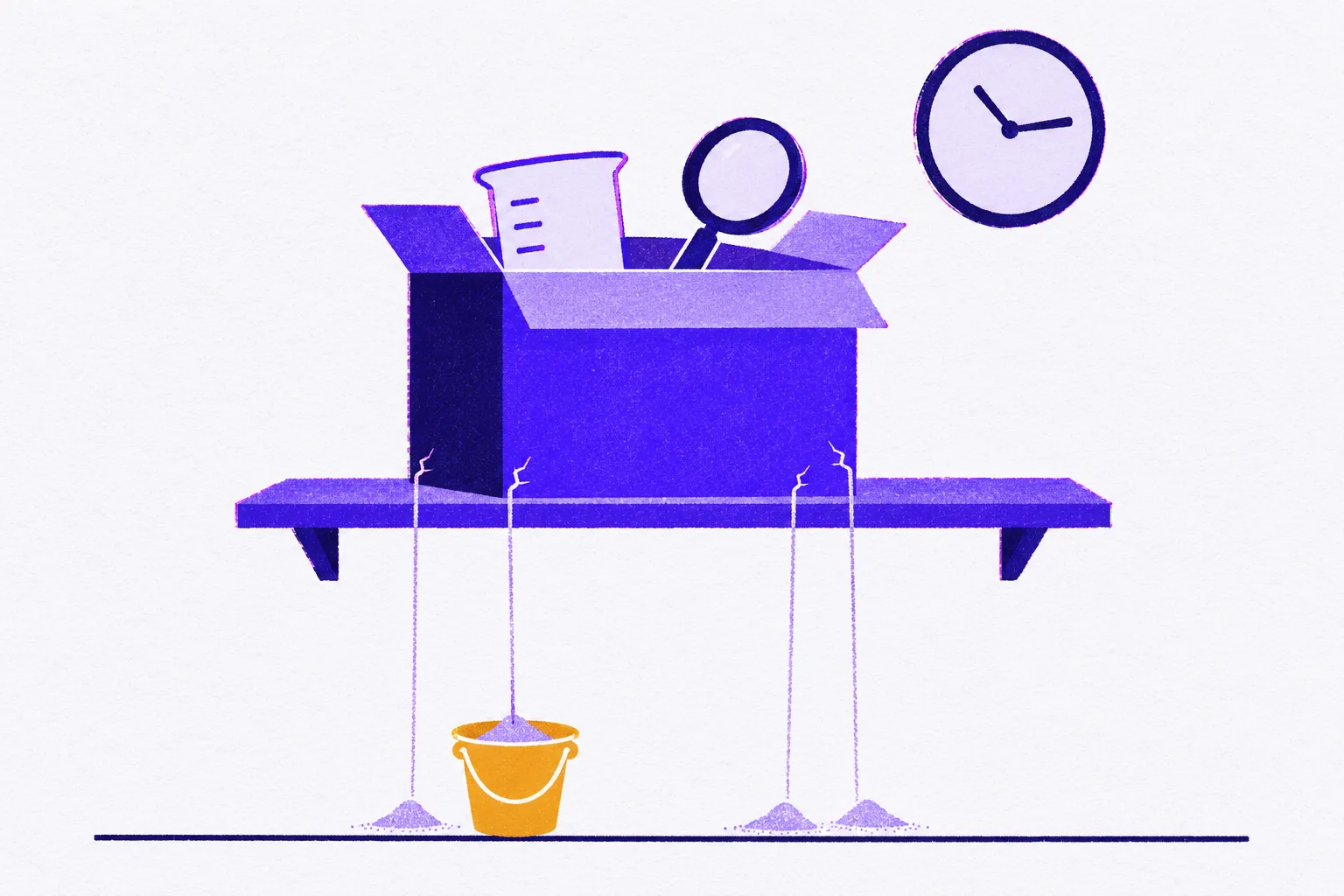
A three-dimensional science classroom needs things a curriculum can’t ship in a box: time on the schedule, support that lasts past the launch, tests that ask for the same thinking, and leaders who know what to look for. Each one leaks in a predictable way. Run your rollout through all four.
1. The Minutes Leak: is there time to teach it?
NGSS units are built around investigations, and investigations take time that elementary science rarely gets. In the 2018 National Survey of Science and Mathematics Education, K-3 classes averaged 18 minutes of science a day, next to 89 minutes of reading and language arts and 57 of math. Grades 4-6 got 27 minutes. Only 17% of K-3 classes had science on all or most days, every week of the year.
A storyline unit written for longer sessions does not survive 18 minutes. Teachers cut the investigation and keep the reading, and the phenomenon shrinks to a picture on the first slide. The fix is a schedule decision, not a curriculum decision. Protect a science block, or build science into the literacy block, where students read data and write arguments from evidence, and count it as ELA time, because it is.
2. The August Leak: does support outlast the launch?
Most NGSS training happens before the first unit. Most of the hard questions show up after it. The same survey found that 43% of elementary teachers had no science professional development at all in the previous three years, and very few had more than 35 hours. Elementary teachers teach science alongside everything else, often without a science background, and a one-day launch can’t carry them through a curriculum built on a different idea of what a lesson is.
Budget for years two and three the way you budgeted for August: coaching inside the units, time for grade-level teams to look at student work together, and a launch session for every teacher hired after the first one. Turnover alone means a real share of your science teachers in year three never got the original training. Our realistic guide for teachers switching curricula is a decent thing to hand them on day one.
3. The Benchmark Leak: does your test ask for the same thinking?
This is the leak I see most often, and it’s the one district leaders control completely. Many state science tests now use sets of questions built around a single scenario or data set. The district benchmark often still looks the way it did before adoption, a list of multiple-choice items that each check one fact. The National Research Council flagged the mismatch in 2014, noting that benchmark tests rely heavily on multiple-choice items that each test a single learning objective, a poor fit for three-dimensional learning.
Teachers notice what gets measured. If the district test rewards vocabulary recall, the investigation turns into vocabulary review by November, and nobody ever has to decide that out loud. Whatever the benchmark measures, the classroom eventually teaches. Put at least one three-dimensional task in every benchmark, a short scenario with data where students make a claim and back it with evidence, and score the explanation along with the answer.
4. The Walkthrough Leak: what do leaders look for?
The last leak lives on the walkthrough form. Plenty of them check fidelity: is the teacher on the right lesson, are the materials out, is the objective posted. All useful, and none of it tells you whether students are doing science. A room can be perfectly on pace while the teacher explains the phenomenon and twenty-six students copy it down.
Two questions do more than a twenty-item checklist. Who is doing the thinking right now, the teacher or the students? And what evidence are students using to back up what they say? Ask those two in every science room for a month and teachers will figure out which questions matter. What leaders look for is what teachers make time for.
Running the Leak Audit on a district in year two
Picture a mid-sized district eighteen months into a new K-8 science curriculum. Scores are flat, teachers are tired, and someone on the cabinet has asked whether they bought the wrong program. Here’s how the audit might play out.
| Leak | What the audit finds | The fix for next year |
|---|---|---|
| Minutes | K-3 schedules science twice a week in the last half hour of the day, and it's the first thing cut | One protected science block, plus science reading and writing counted inside the literacy block |
| August | The launch training was strong, but a fifth of this year's teachers were hired after it | Coaching cycles inside two units per grade, and a launch session for every new hire |
| Benchmark | The fall and winter benchmarks are 30 multiple-choice items each | Swap five items for one scenario task that asks for a claim and evidence |
| Walkthrough | The form checks pacing and posted objectives | Two questions: who's doing the thinking, and what evidence students are using |
Notice what’s missing from the list: a new curriculum. The program was doing its job. Switching would have reset the clock and walked the district right back to the edge of the cliff, with new binders.
Where Missions fit in an NGSS rollout
Full disclosure again: Mission.io is ours, so weigh this section accordingly. Missions don’t replace a core curriculum, and we’d tell you not to buy them as one. They fit inside the units you already have. A Mission is a teacher-led, whole-class simulation built from a standard. The class becomes a spaceship crew or a lab team, and students have to read data, figure out what’s going wrong, argue from evidence, and make the calls together. That’s the thinking your benchmark should be asking for, happening where a principal can see it from the doorway.
Missions also help with two of the leaks directly. Prep is picking the Mission, and our software runs the work at each station, so a teacher who missed the August training can run one well in the first week. And because students read data and write explanations along the way, a Mission can earn some of its time from the literacy block.
We’ve put that to the test. In a 2025-26 study of 1,039 fifth graders across 53 classrooms, conducted by Instructure and funded by the U.S. Department of Education’s Institute of Education Sciences, students who ran Missions scored significantly higher in content knowledge than students who didn’t (g = 0.335, p < .001), and the more Missions they ran, the higher they scored (+0.0094 proportion correct per session, p < .001). They also scored significantly higher on writing performance (g = 0.269, p = .015), with scores rising the more Missions they ran (+0.035 rubric points per session, p = .049). The study meets ESSA’s Moderate Evidence bar (Level II).
For picks by grade, start with our science activities by grade. To see how Missions pair with each major program, from Amplify to OpenSciEd, see our guide to the best NGSS science curriculum.
Patch the leaks before you buy the next box
When an NGSS rollout stalls, the instinct is to go shopping. A new program comes with a new launch, new kits, and a new August, and for a year it feels like progress. Then the same four leaks drain it, because nobody patched them. Before your next adoption meeting, run the Leak Audit on the curriculum you already own. Then go stand in that fourth-grade room at 2:40 on a Thursday and see what changed.
Frequently asked questions
Why does NGSS implementation fail?
NGSS implementation usually fails after adoption rather than at it. The common causes are too little science time in the elementary grades, professional learning that ends after the launch, district benchmarks that still test recall with single-fact multiple-choice items, and walkthroughs that check pacing instead of whether students are reasoning from evidence. The Leak Audit checks all four.
How long does NGSS implementation take?
Plan in years, not months. Year one covers materials and launch training. Changing how science is taught takes coaching, aligned assessments, and leadership attention in years two and three. Districts that budget only for the first year often see results stall, a drop-off we call the Year-Two Cliff.
How much time do elementary students spend on science?
Not much. The 2018 National Survey of Science and Mathematics Education found that K-3 classes averaged 18 minutes of science a day and grades 4-6 averaged 27, compared with 89 minutes of reading and language arts in K-3. Districts implementing NGSS can protect a science block or count science reading and writing inside the literacy block.
How do you assess NGSS in the classroom?
Use tasks where students explain a phenomenon or analyze data, make a claim, and support it with evidence, instead of single-fact multiple-choice items. The National Research Council’s 2014 report on NGSS assessment calls for tasks that combine all three dimensions. A practical first step is adding one scenario-based task to each district benchmark and scoring the explanation.
What should leaders look for in an NGSS walkthrough?
Ask two questions in every science room: who is doing the thinking, the teacher or the students, and what evidence are students using to support their ideas? Students gathering information, reasoning from evidence, and defending claims out loud are stronger signs of NGSS-style instruction than pacing, posted objectives, or materials on the table.
What is the Year-Two Cliff?
The Year-Two Cliff is the drop-off that follows the first year of a new science curriculum, when launch funding, training, and leadership attention run out but the classroom shift is still under way. Teachers drift back to familiar routines, and the district often blames the curriculum. Planning support for years two and three prevents it.