
Share this
by Grace Balena on March 12, 2026
This morning, I woke up, put on the shoes I laid out, grabbed my lunch, and headed out the door. I followed my usual morning routine, knowing exactly where my toothbrush and vitamins were. Without these habits built into my day, getting ready in the morning would be much more stressful. I might not be able to find my favorite pair of shoes, waste time looking for them, and begin my day feeling unproductive and upset.
Introduction: Why Routines Matter More Than You Think
Just like my mornings, students benefit from stable, predictable routines. Classroom routines are the backbone of student confidence and attention.
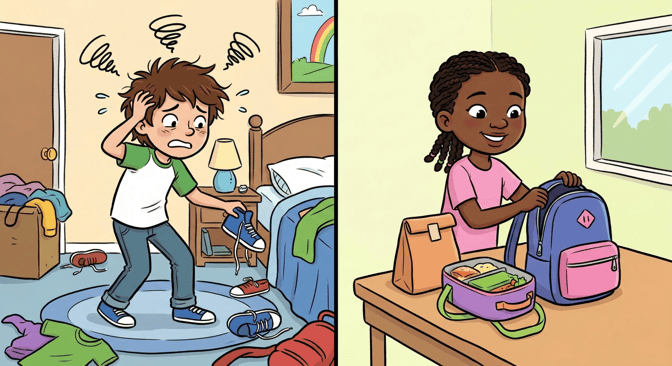
Routines reduce friction. For teachers and for students, the convenience of routines removes the question of “What next?”
If you stick around, we’ll go over some practical, scaffolded routines that will support student engagement, reduce disruption, and build classroom culture. Maybe the idea of classroom routines feels uninspiring and soul-crushing. We promise that by becoming comfortable with established routines, you will be able to maximize the joy of learning with ease.
Foundations of Effective Routines
It is important to distinguish between routines and rules. Classroom rules are hard and fast guidelines for your classroom. Raise your hand before speaking. Use an inside voice when inside. Don’t jump on desks. You get the idea…
Classroom routines (sometimes called classroom procedures) are sequences of actions regularly followed. They often begin as established, step-by-step instructions for how to complete a certain task. Eventually, however, they become habits. Students follow routines instinctually, and everything runs smoothly.
Routines reduce the cognitive load on both students and teachers. It supports executive functioning because when the brain has the choice between forging a new path or following an established routine, it is much more likely to follow the path of least resistance.
Strong classroom routines are consistent, happening at the same times and after the same activities, and usually often. Routines should be clear, and beginning with a set of written instructions can be helpful for reminding students of longer and more complex routines. And lastly, routines should be easy to remember.
Types of Classroom Routines You Need
Beginning & Entry Routines
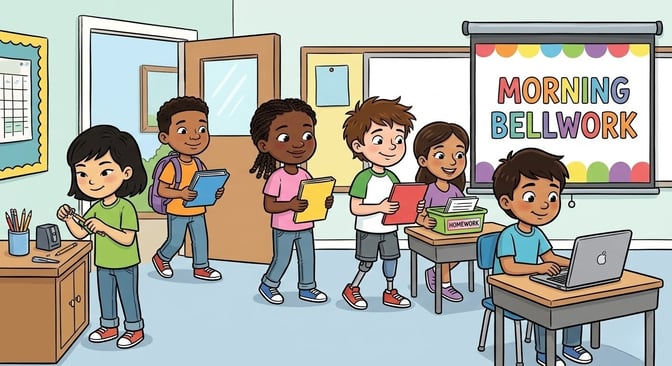
Momentum is a fragile thing, and it is won or lost in the first five minutes of the day. Effective entry routines ensure that students hit the ground running rather than stumbling over disorganized backpacks. When students know exactly where to sharpen their pencils, where to turn in last night's homework, and which bellwork task to start immediately, they bypass the morning fog. By ensuring everyone has the necessary computers, folders, pencils, etc. before the first lesson begins, you eliminate the friction of, "I forgot my book!" halfway through a lecture. A predictable start creates a calm, focused environment that carries through until the final bell.
Transitions & Movement Routines
If a classroom is going to descend into chaos, it usually happens during the in-between moments. Transitions are high-stakes periods where teacher vigilance must be at its peak. Moving from desks to the carpet or shifting from a lecture to a lab are volatile activities that can swallow instructional time if left to chance. Establish a clear cadence for cleaning up and lining up to preserve your sanity. When students follow a practiced sequence for pushing in chairs and forming a quiet line, you are protecting the minutes you need for actual teaching.
Materials & Supplies Routines
A classroom can quickly begin to resemble a rat’s nest if there isn't a systemic approach to "stuff." To keep your floor visible and your mind clear, implement specific routines for distributing and collecting supplies. When you use assigned class helpers, the goal is to limit the number of students wandering around at once. Be explicit: tell students to pass papers to the front of the row, or remind them that only one group may return their laptops to the charging cart at a time. Simple maintenance, like a weekly five-minute desk purge or assigned cleaning jobs after a science lab, will ensure your workspace remains a place of learning rather than a hoarder's convention.
Group & Collaboration Routines
Group work shouldn't be a social free-for-all. To avoid the inevitable bickering over friend group drama or the rules of freeze tag, use pre-assigned table groups or a quick numbering-off system. Communication routines are just as vital. Establish protocols where students must listen to a peer’s complete thought before responding. To signal the end of a discussion without shouting over the din, have students use a non-verbal signal like raising a peace sign. The more peace, the better.
Independent Work & Exit routines
The transition to independent work requires a clear roadmap. When students finish their main task, a visible list on the board should guide them through their options: finishing late work, reading silently, or working on a puzzle. This prevents the dreaded growing chatter that turns cacophonous before you can put an end to it. Similarly, the end of the day should not feel like the grand opening of an amusement park. Packing up should only occur when you give the signal, and students should remain in their seats until formally dismissed. It’s a final daily exercise in respecting the teacher’s time and one another’s focus.
Classroom Systems & Environmental Routines
Sometimes, the best routines are the ones that don't require you to say a word. Environmental routines, like using specific hand signals for bathroom breaks or a designated hall pass, keep the classroom flowing without interrupting a lesson. Visual cues are your best friend here. Use anchor charts to map out the steps of complex procedures, serving as a permanent reference for students as they build these habits. Sometimes I think I could use an anchor chart in my kitchen. I’ve tossed enough metal spoons in the trash to know that even adults benefit from well-placed reminders.
Teaching Routines: The Gradual Release Model
To turn a new procedure into an instinctual habit, many educators turn to the Gradual Release of Responsibility model. Think of it as the "I do, We do, You do" approach. It begins with the teacher taking full responsibility for the task and slowly shifting that weight to the students until they can perform the routine independently with minimal support. It is a popular and highly effective framework because it replaces guesswork with confidence.
Explicit Modeling
The first step is pure demonstration. Practice thinking aloud. As you work through a problem on the board, narrate your internal monologue. This is the time to provide step-by-step written instructions on a poster or assignment sheet. Show them how to identify a mistake and, more importantly, how to course-correct. Students already grappling with new content shouldn't have to guess at the basic mechanics of the task.
Guided Practice
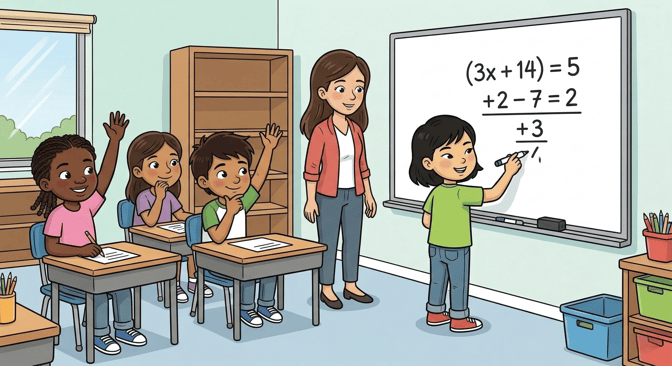
Once you’ve set the stage, it’s time to let the students rehearse while the information is still fresh. This is the guided phase where you begin to let go of their hand – but only a little. Have a few students come to the board to solve problems while their peers offer suggestions, or have the whole class work through a sample together. Your role here is to circulate, perform constant checks for understanding, and provide immediate feedback. It is essential to foster an environment where mistakes are welcome, ensuring that misconceptions are nipped in the bud.
Fading Support
In this stage, the training wheels come off. Collaborative work is the hallmark of fading support, allowing students to test their skills with their peers. You should reduce the number of prompts and scaffolds provided during the guided practice phase. This is often the most challenging step for both parties. For the teacher, it requires finding the sweet spot between being helpful and letting students struggle meaningfully.
Sealing the Deal
To ensure success, have students construct their own learning “toolkits,” complete with a personal flowchart, a desk-side memory aid, or a contribution to a classroom anchor chart. If the routine is central to a long-term unit, put up a poster for the class. This final handoff transforms a classroom procedure into a personal skill.
Student Engagement & Ownership in Routines
This story on the power of giving students autonomy shows that for students to be most effective and happy, they need to have autonomy. In other words, when they feel in control and have a good connection with their teachers, they are more motivated and engaged.
So often, students are afforded very little autonomy at school, are expected to perform tasks that they are barely competent in, and are barred from speaking with their peers to maintain a quiet classroom. Foster mutual understanding between you and your students. We’re not saying you have to sit down with a juice box and play kickball with them (even though you would clearly be the fastest and best asset for their team), but sharing a sense of solidarity can help both you and your students feel more connected and improve classroom relationships. They’ll care about your routines if they see the positive effects of order in the classroom.
Maintenance, Calibration & Iteration
When a routine starts to crumble, don't just push through the chaos. It’s okay to hit the pause button (commonly mistaken for the snooze button…). Take a day to revisit and redefine the procedure with your students to ensure the foundation is still solid.
Consistent maintenance requires a toolkit of verbal, visual, and choral cues to keep everyone on track. Think of these as the calendar alerts for your classroom. Don't be the forgetful boyfriend of teaching who lets your anniversary slide. Everyone needs some way to stay organized.
A routine that worked for twenty 2nd graders won't necessarily translate to thirty-five freshmen. Never copy your procedures without a little proofreading. After all, you wouldn't teach 7th graders their ABCs, so don't give them a routine they've already outgrown.
Integrating Routines with Classroom Culture & Relationships
Every procedure in your handbook is an opportunity to promote a classroom value. When students engage in a consistent bellwork routine, they are proving their work ethic. Likewise, a routine for active listening is a tangible expression of respect for their peers' voices (even though it is also to mitigate your noise-related headaches).
Predictability is essential for feeling comfortable and safe in the classroom. When students know exactly how to participate or ask for help, they take more academic risks because you’ve removed a barrier to entry. Most routines, at their core, are simply a framework for treating one another with respect.
Don’t let your procedures become mindless. Periodically ask your students why a specific routine exists and how it helps the community. It is far more meaningful for a student to understand the purpose of a transition in their own words than to simply follow a command.
Common Pitfalls & Mistakes to Avoid
No matter how invigorated you feel reading this right now, a good thing takes time. Attempting to implement twenty new routines mid-semester, or even on the first day of school, is a recipe for burnout. Integrate routines slowly and carefully to ensure they actually stick.
Rigidly ignoring student needs and context is counterproductive. Give grace to the student who has always struggled with time management or the high-achiever who simply forgets to push in their chair. Standing strong in your beliefs doesn't mean you have to turn punitive when a student is learning a new skill.
Routines are not set-in-stone, nor are they etched inside the brains of your students. Provide continual reminders and, if a student asks for clarification in earnest, re-explain the steps without making them feel like a burden. Take it as a compliment that they want to follow your routine and are curious enough to ask a question in the first place.
If your routines are built solely for control rather than learning, you’ve become a dictator, not an educator. The ultimate purpose of a procedure is to promote growth. If students feel excluded or frustrated by a routine, reconsider the purpose of the procedure and adjust as necessary.
Using Technology & Cues to Support Routines
Visual timers are a game-changer for helping students internalize time management. When a countdown is visible on the board, transitions stop being an abstract request and become a tangible goal. And really, everyone knows exactly how long they have to get those pencils put away. Consistent daily slideshows reinforce this by keeping homework, announcements, and instructions in the same expected spot every single morning.
Examples Across Grades & Subjects
Regardless of the grade level, the secret is to start small. Building fundamental routines every single day creates a predictable rhythm that provides students with both a sense of comfort and the discipline needed for deep work.
Sample routines for elementary, middle, and high school
- Elementary: A simple, independent to-do list that gives instructions for finishing classwork and projects, and that helps students work on developing their responsibility and consistency.
- Middle school: Instructions written on the board for students to quietly enter the classroom and begin preparing for the day.
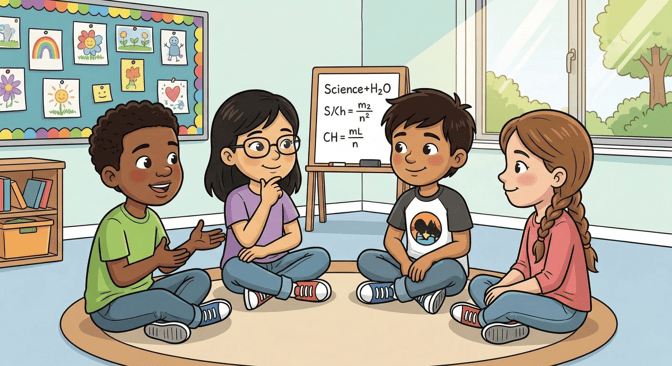
- High school: Teach students to arrange their desks in a circle for a class discussion or to move into discussion groups every Friday to review big concepts and questions from the week.
Sample Routines for Literacy, Math, and Science
- Literacy: A "Status of the Class" routine where students give a quick thumb-signal to indicate their current reading progress before independent work.
- Math: A "Warm-Up Hand-Off" where a different student solves the first problem of the day on the board while everyone collaborates to help them.
- Science Lab: A "Station Sanitization" routine where the last three minutes are strictly for clearing surfaces and accounting for all supplies.
Conclusion: From Routine to Flow
When routines are executed with consistency, they eventually disappear into the background, leaving behind a state of instructional flow. You stop being a traffic cop and start being a facilitator of ideas.
Which specific routine in your classroom feels weak right now? What daily activities could be redesigned by the students themselves to increase engagement?
Integrating technology in your routines can be a great learning experience for students navigating the digital age. Using Missions to provide students with engaging learning experiences can become a natural, fun routine that students look forward to. A Mission right after a lesson can help students consistently practice new material and engage with their classmates, and be a productive, collaborative use of technology.
Your Action Plan
Don't feel pressured to remodel your entire class structure overnight. Introduce one new routine next week. Model it, practice it, and be flexible and supportive based on how your students respond.
Your students will appreciate the time you take to make the day-to-day predictable and engaging for them. If you’re interested in more ways to connect with your students, read our blog on how to Strengthen Trust with Students in 15 Simple Ways.