
Share this
by Ryann Garland on December 2, 2025

In a traditional classroom, the teacher explains and the students repeat, but contrary to popular belief, teachers don’t have to know all the answers. In fact, some of the best classroom experiences come from students asking, investigating, and answering their own questions. Today’s students don’t just need facts to memorize, but fuel for curiosity and opportunities to put knowledge into action. That’s where inquiry-based learning changes the game. Instead of being passive recipients of information, students step into the driver’s seat, asking their own questions, leading investigations, and solving real-world problems. If you’ve ever said, “Because I said so” during a lesson, inquiry-based learning might feel a little like rehab (but in a good way).
The results? Stronger critical thinking skills, resilience, and a love of learning that doesn’t end when the bell rings. Inquiry builds the skills and mindsets that prepare learners for life beyond the classroom.
And with Mission.io, teachers don’t have to reinvent the wheel. Our immersive, story-driven Missions bring the inquiry process to life, making every lesson radically engaging and measurable.
What Is Inquiry-Based Learning?
Inquiry-based learning is a student-centered approach where learners actively investigate instead of passively listening. Instead of a teacher standing at the front delivering facts, students lead with curiosity, asking their own questions, pursuing evidence, and constructing understanding through discovery. Think of it as “curiosity with a game plan” (and less Wikipedia rabbit holes).
This approach mirrors the scientific method, making it particularly powerful in science education, but it can be applied across all subject areas. Rather than performing rote memorization, students create meaning through authentic engagement with problems and concepts.
The National Research Council supports this approach, emphasizing how inquiry helps students develop knowledge, understanding, and enduring problem-solving skills. Long story short: inquiry-based learning is less “copy this off the board” and more “let’s figure out why the board even exists.”
The Teacher’s Role
In an inquiry-based classroom, teachers are curiosity curators. Think of yourself as the Curiosity DJ: you’re not singing along or leading karaoke, but you're spinning the right tracks to keep the party (or the learning) going. Your job is to design the environment, pose challenges, and scaffold support without stealing the struggle from students. Instead of providing every answer, you facilitate the journey. Rather than dictating the discussion, you guide discourse and encourage different viewpoints. These efforts create room for exploration and new ideas.

Your new job title? Chief Curiosity Officer. Business cards optional, enthusiasm required. Go ahead and slap that up on your LinkedIn.
The Student’s Role
Meanwhile, students step into the role of researcher, explorer, and collaborator. They ask questions that matter to them, investigate problems, and collect evidence. They share findings, debate with peers, and refine their ideas. And when they fail, they revise and fail forward, building resilience with every iteration.
Active student-led learning helps students develop not only content knowledge but also inquiry skills, collaboration, and confidence in leading their own learning. Instead of filling out worksheets, they’re solving authentic, real-world problems. It’s like letting students drive the car while you calmly hold the invisible brake pedal.
Together, with teachers as guides and students as explorers, you can create classrooms where curiosity drives learning, and discovery becomes the ultimate outcome.
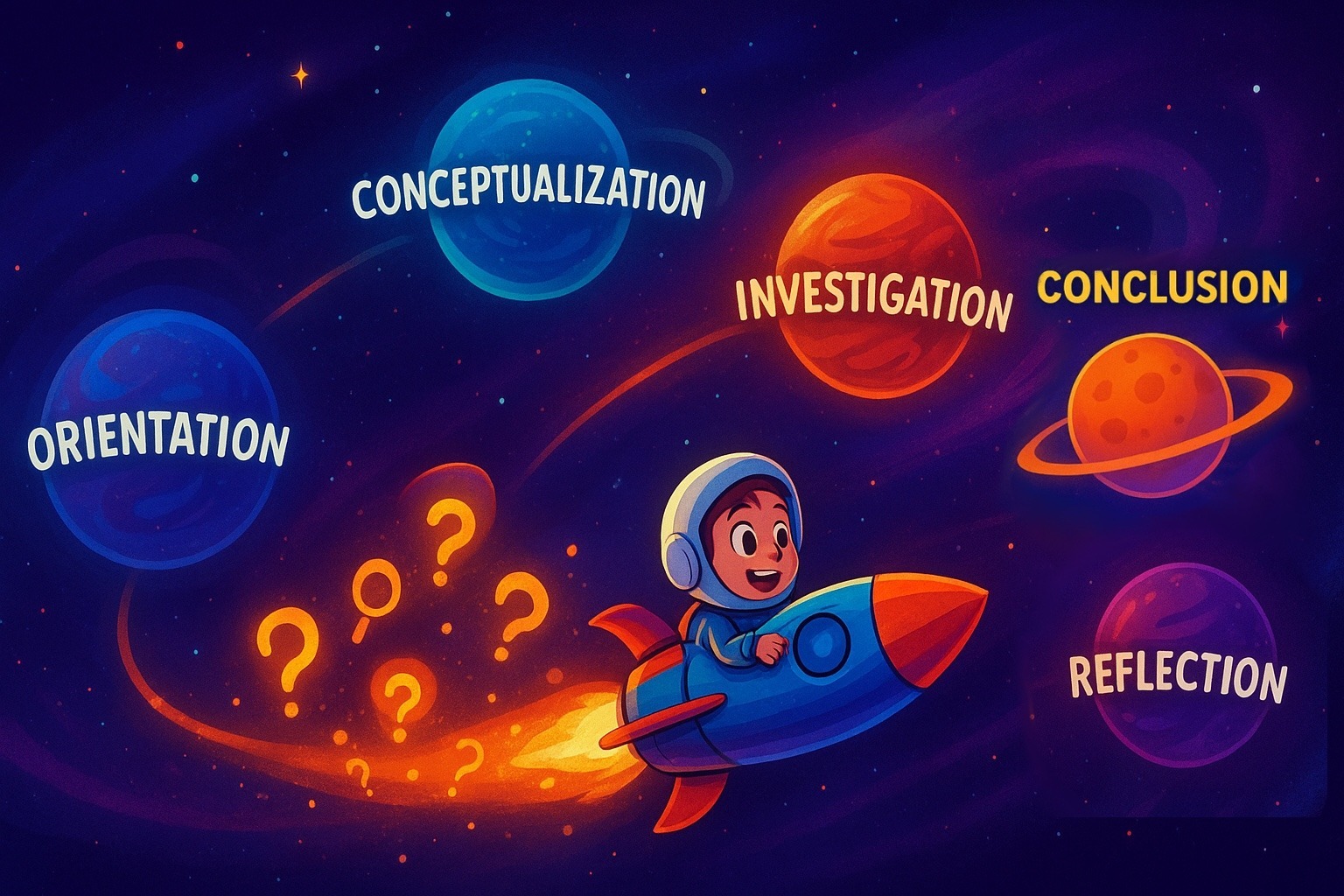
The 5 Steps of the Inquiry-Based Learning Process
Every effective inquiry journey follows a cycle. These steps give structure to curiosity and provide a roadmap for deeper learning. Here’s how the inquiry process breaks down.
Orientation – Spark Curiosity with a Central Question
Inquiry begins with curiosity. In the orientation phase, the teacher introduces a bold central question or scenario designed to grab attention and make students wonder, “What if?” This stage is about setting the hook and fueling student curiosity so that learners feel compelled to explore further.
In science education, this might look like presenting a strange phenomenon and asking students to explain it. In social studies, it might mean analyzing a historical decision and debating its outcomes.
Conceptualization – Plan and Form Hypotheses
Once students are hooked, they move into the conceptualization phase. Here, they begin designing their own inquiry by brainstorming questions, making predictions, and mapping out how they’ll investigate the problem. Teachers act as guides, helping students refine vague ideas into testable student questions and workable plans.
For example, in a guided inquiry approach, the teacher may provide the problem while students decide which tools, methods, or sources of knowledge they’ll use.
Investigation – Explore, Research, and Experiment
This is the phase where things get delightfully messy. Students investigate, test ideas, research, and experiment to pursue answers to their questions. It’s the messy middle where trial and error becomes an essential part of the learning process. Students might collect data, run experiments, conduct interviews, or debate different viewpoints with their peers. They learn resilience by trying, failing, and trying again.
Tools like Mission.io can amplify this phase by providing immersive, gamified challenges that require students to analyze information, apply knowledge, and develop solutions collaboratively. In this stage, learners are practicing the scientific process and applying inquiry skills to real-world problems.
Conclusion – Analyze and Share Findings
After the exploration comes meaning-making. In the conclusion phase, students analyze their findings, determine what the evidence shows, and construct explanations.
This stage helps students develop critical thinking by moving beyond surface-level answers to a deeper understanding. Sharing results is just as important, whether through presentations, debates, or collaborative discussions, because it reinforces communication skills and allows the class to build shared knowledge. This is where the lightbulbs go off (sometimes literally, if you’re teaching physics).
Reflection – Apply Learning Beyond the Lesson
The final step of the cycle is reflection. Here, students step back to think about what worked, what didn’t, and how they might approach the problem differently next time. Reflection is about recognizing growth and making connections to new contexts. Students consider how they can apply knowledge and skills to future challenges, both inside and outside the classroom. This phase nurtures metacognition, helping learners take ownership of their own learning journey.
This five-step inquiry cycle ensures students aren’t just memorizing content but actively building transferable skills like collaboration, problem solving, and critical thinking. With the right support and the right tools, inquiry-based learning becomes more than a classroom strategy; it becomes preparation for the real world.
The Benefits of Inquiry-Based Learning
Why switch to inquiry learning? The many benefits speak for themselves:
Students Gain Ownership of Their Learning
Inquiry empowers learners to take control of the learning process, making decisions, asking their own questions, and driving their own inquiry. This independence builds confidence and helps students become lifelong learners.
Inquiry Builds Critical Thinking and Problem-Solving Skills
By evaluating evidence, testing ideas, and navigating uncertainty, students strengthen critical thinking skills and develop real-world problem-solving skills. For more strategies on building these abilities, check out our guide on how to improve critical thinking in the classroom.
Collaboration Becomes Authentic
In an inquiry-rich classroom, teamwork is more than “group work.” Students truly collaborate as they share ideas, debate solutions, and make sense of concepts together—just like professionals do in the real world.
Inquiry Bridges Subject Areas and Grade Levels
Inquiry naturally connects across disciplines, blending science, math, and even social studies into one rich experience. This interdisciplinary approach makes learning relevant, flexible, and adaptable across different grade levels.
Curiosity and Motivation Stay Alive
The heart of inquiry is student curiosity, which fuels engagement and persistence. When students know their questions matter, they stay motivated to explore, discover, and push their own understanding further.
In short, inquiry helps students learn in a way that sticks. This builds knowledge together with the skills and confidence to keep questioning long after the lesson ends.
How to Plan an Inquiry-Based Lesson
So how do you pull it off without losing your sanity? Here’s a blueprint for planning an effective, engaging inquiry lesson:
-
Start With a Central Question
Every strong inquiry lesson begins with a central question that sparks curiosity and sets the tone for exploration. In three-dimensional (3-D) science learning, this question often grows out of a compelling phenomenon, something observable that students can wonder about and seek to explain. The question should be open-ended, tied to a real-world problem, and engaging enough to make students eager to investigate.
-
Choose the Right Inquiry Type
Not all inquiry looks the same. Try choosing from the four main inquiry approaches to best balance structure and independence, depending on the needs of your classroom.
- Structured inquiry provides the question and steps, ideal for beginners.
- Guided inquiry lets students design their own investigation while still working from a teacher-provided question.
- Open-ended inquiry gives students freedom to generate their own questions and plans.
- Problem-based inquiry emphasizes collaboration around authentic, real-world challenges.
Design for Exploration and Collaboration
Inquiry thrives when students have room to test, debate, and revise their ideas. Encourage collaboration and different viewpoints, so students learn how to problem-solve as a team. Building in structured discussion and opportunities for iteration helps engagement soar.
Focus on Process, Not Perfection
The power of inquiry lies in the learning process, not in arriving at a single “right” answer. Teachers should normalize mistakes, highlight the value of evidence-based answers, and connect every step back to the scientific process.
Supercharge With Mission.io
This is where Mission.io makes inquiry effortless, because truthfully sometimes the best classroom management is just really good storytelling. With immersive, story-driven missions, students investigate meaningful problems, work together in teams, and develop innovative solutions. Each Mission is designed for radical engagement, while giving teachers built-in ways to measure collaboration, resilience, and critical thinking.
Think of Mission.io as your inquiry autopilot. The students steer and you make sure no one flies directly into a meteor shower.
Embrace the Mess
Inquiry can feel unpredictable, but that’s part of its power. With Mission.io, time constraints are solved through plug-and-play designs, chaos is managed by the clear structure of the inquiry cycle, and motivation is boosted by gamified experiences rated higher than recess. The key is to lean into the mess — it’s where the magic of learning happens.
The Future of Inquiry-Based Learning Is Mission-Powered
Inquiry-based learning moves classrooms beyond worksheets and lectures to experiences that fuel curiosity, build critical thinking, and prepare students for the real world.
But you don’t have to build it from scratch. With Mission.io, you can instantly embed inquiry-based instruction into your classroom. Choose from 100+ immersive Missions that fit seamlessly into your curriculum. No logins, no extra prep — just students investigating, collaborating, and creating solutions in ways they’ll never forget.
Ready to spark curiosity and watch your classroom come alive? Run your first Mission today and let the inquiry begin.